
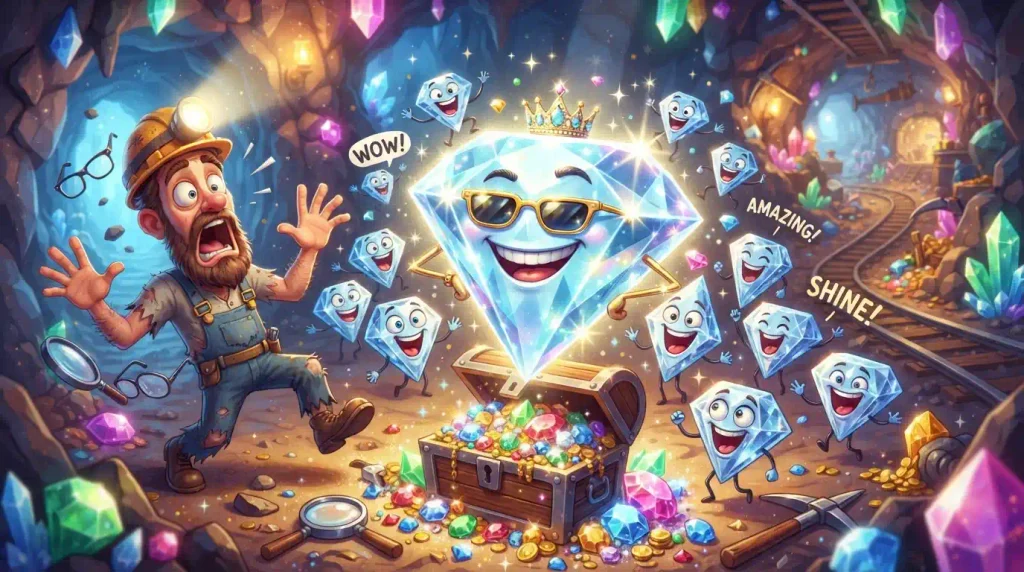
Diamonds are ancient carbon crystals formed deep within Earth under extreme pressure and heat over billions of years. Famous for being the hardest natural substance on Earth, diamonds are prized for their brilliance, unique industrial uses, rare color variations, and fascinating extraterrestrial presence across the universe.
Have you ever wondered what makes a tiny sparkler deep inside the Earth so incredibly valuable and mesmerizing? Exploring these extraordinary diamond fun facts reveals just how wild, mysterious, and surprisingly cool these natural gemstones really are.
When you look at a sparkling piece of jewelry, you are actually holding a piece of deep Earth history that survived incredible heat and pressure. Learning these diamond fun facts shows that there is way more to these shiny rocks than just romantic engagement rings and glamorous red-carpet fashion.
Get ready to impress your friends with mind-blowing trivia about cosmic gems, ancient legends, and super-hard scientific wonders. Let’s take a close look at the most fascinating diamond fun facts you never knew existed!
How Are Diamonds Formed Deep Inside the Earth?
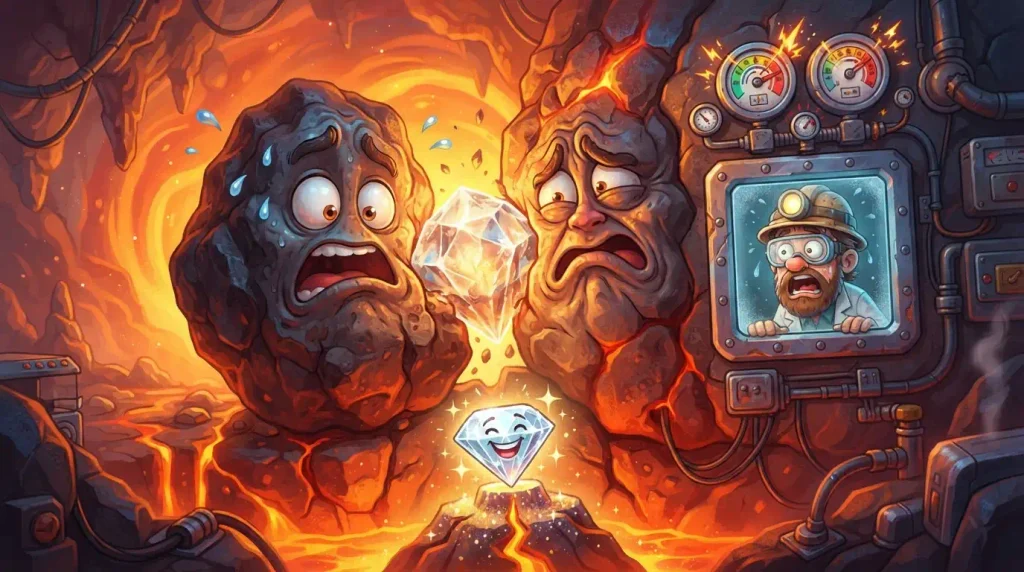
Most people assume diamonds are made from compressed coal, but that is actually a popular scientific myth. Coal comes from prehistoric land plants, while diamonds formed way deeper in the mantle long before land plants ever existed on our planet.
Diamonds are pure carbon atoms locked into a tight crystal structure under mind-boggling pressure and heat. They travel toward the surface through explosive deep-source volcanic eruptions that create rare rock shafts called kimberlite pipes.
The Epic Journey from the Mantle
The journey of a natural gem starts between 90 and 120 miles below the surface of the Earth. Up in the crust where we live, conditions are far too weak to squeeze carbon into a sparkling diamond structure.
The intense weight of the upper layers creates crushing forces over tens of thousands of atmospheres. Combined with scorching volcanic heat, carbon atoms link together into ultra-strong atomic bonds that last forever.
Millions or Billions of Years Old?
If you own a diamond, you are wearing an ancient geological antique. Most natural diamonds recovered today formed between 1 billion and 3.5 billion years ago.
To put that into perspective, some of these stones were already ancient when dinosaurs walked the Earth. The younger diamonds are still hundreds of millions of years old, making them older than almost anything else you can touch.
Amazing Scientific Diamond Fun Facts
Science reveals that these glittering crystals possess physical properties unlike any other natural material found on Earth. Their unique atomic makeup makes them prized industrial tools as well as priceless decorative jewels.
The Hardest Natural Substance on Earth
Diamonds rank at a maximum of 10 on the Mohs Hardness Scale, making them the absolute hardest natural mineral known. In fact, the only thing that can scratch a diamond is another diamond.
Because of this extreme strength, industrial-grade stones are routinely crushed into abrasive dust or used on high-speed saw blades. They slice through solid granite, heavy concrete, and thick metal with total ease.
Pure Carbon in a Perfect Grid
It might shock you to learn that a diamond shares the same chemical element as soft pencil lead. Both graphite and diamond consist entirely of pure carbon atoms.
The critical difference lies in how those carbon atoms bond together under pressure. Graphite forms loose, slippery sheets, while diamonds form a rigid, interlocking three-dimensional crystal lattice.
Can You Destroy a Diamond?
Even though diamonds are nearly impossible to scratch, they are not completely indestructible. If you hit a diamond at just the right angle with a heavy hammer, it can easily shatter along its natural cleavage planes.
Additionally, because diamonds are pure carbon, they can actually burn away into invisible carbon dioxide gas. If exposed to an open flame over 1,500 degrees Fahrenheit, a diamond will simply vaporize into thin air.
Extraterrestrial Diamonds Beyond Our World
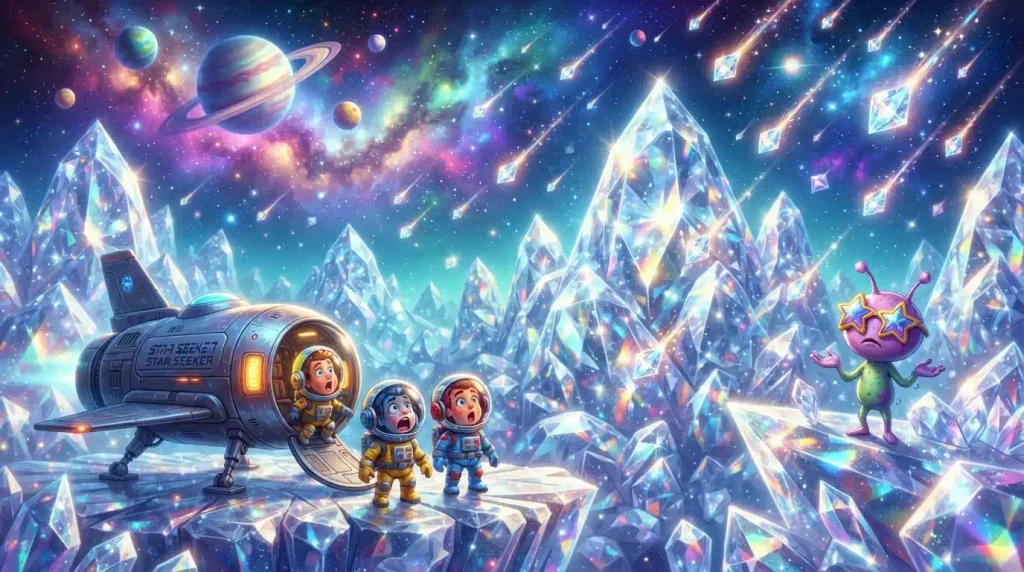
The Earth is not the only place in the universe where sparkly carbon crystals exist. Space scientists have uncovered incredible cosmic phenomena showing that diamonds are actually scattered across our galaxy.
Giant Space Diamonds in the Sky
In 2004, astronomers discovered a massive dying star composed of crystallized carbon located 50 light-years away in the constellation Centaurus. This cosmic giant is effectively a 10-billion-trillion-trillion-carat diamond floating quietly through deep space.
Scientists playfully named this giant cosmic crystal “Lucy” after the famous Beatles song. It represents the ultimate space treasure that dwarf stars leave behind after running out of fuel.
Raining Diamonds on Giant Planets
Deep inside the thick, pressurized atmospheres of Neptune and Uranus, conditions are truly out of this world. Methane gas gets crushed by intense gravitational forces, splitting methane molecules into hydrogen and carbon atoms.
The loose carbon sinks deeper into the planet; high pressure turns it into solid diamond crystals, and it literally rains sparkling diamonds inside those outer giant gas planets.
The Colorful World of Rare Fancy Diamonds
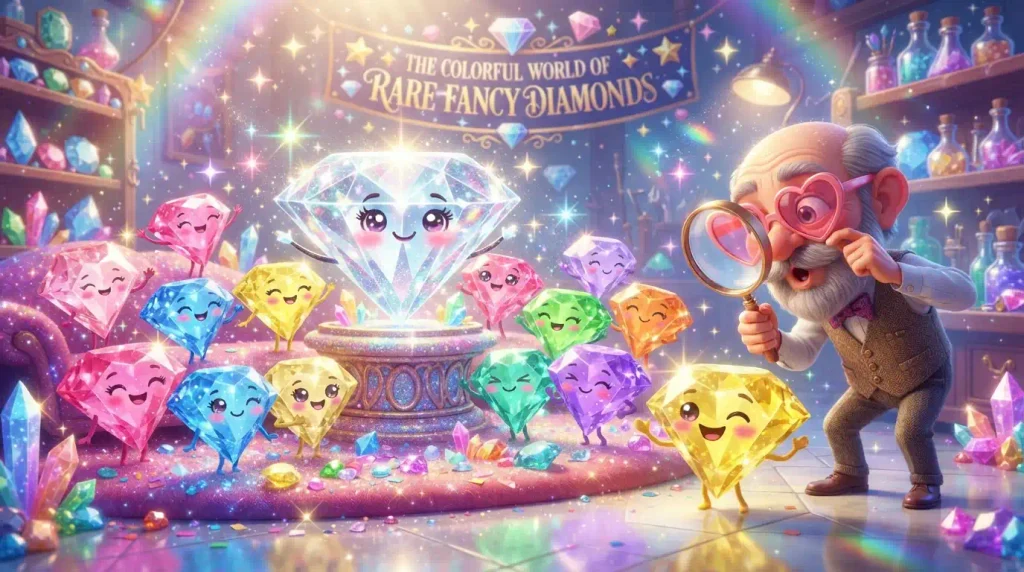
When most people imagine a classic engagement stone, they picture a clear, colorless gem sparkling in the light. However, diamonds can naturally occur in almost every single color of the rainbow.
How Colors Form Naturally
Fancy colors occur when trace elements get trapped inside the carbon grid during the original growth process. Minute amounts of boron create vibrant blue tones, while trapped nitrogen atoms create rich yellow shades.
Structural distortions caused by immense tectonic pressure can also alter how light passes through the stone. This natural warping process creates stunning pink, red, and brown hues.
The World’s Rarest Color
Red diamonds are officially the rarest, most valuable gems on the entire planet. Only a tiny handful of pure red stones have ever been mined in recorded human history.
Most red diamonds are so famous and tiny that even a stone weighing under one single carat can easily fetch millions of dollars at elite luxury auctions.
Diamond History and Ancient Myths

Human beings have been utterly obsessed with sparkling carbon gems for thousands of years. Long before modern gem cutters figured out how to make them sparkle, ancient cultures viewed them as magical gifts.
Ancient Greek Tears of the Gods
Ancient Greeks believed that natural uncut diamonds were actual tears cried by powerful gods living in the sky. Others believed they were tiny splinters that broke off falling shooting stars.
The word “diamond” comes directly from the ancient Greek word adamas, which translates to “unconquerable” or “invincible” due to the stone’s legendary durability.
Poison Testing and Invisibility Powers
In medieval Europe, kings carried raw diamonds into battle as protective amulets against bad luck and physical harm. They believed these stones could heal illnesses, cure poisonings, and render soldiers invisible on the battlefield.
Some ancient Indian texts advised placing raw diamonds in home corners to ward off lightning strikes, evil spirits, and dangerous dark magic.
Famous Diamonds with Incredible Stories

Certain famous stones have captivated world leaders, royal families, and historians for centuries due to their massive size and fascinating backstories.
The Hope Diamond and Its Legendary Curse
The Hope Diamond is perhaps the most famous rare blue stone in human history. Weighing over 45 carats, it exhibits a spooky party trick: it glows deep red under ultraviolet light long after the lamp is turned off.
Legend claims the stone carries a terrible curse that brings doom, tragedy, and bad luck to anyone who buys or wears it. Today, it sits safely behind protective glass at the Smithsonian Institution.
The Massive Cullinan Diamond
Mined in South Africa back in 1905, the legendary Cullinan Diamond was the largest gem-quality rough stone ever discovered. It weighed an unbelievable 3,106 carats, roughly the size of an adult human heart.
The massive rock was eventually cut into nine large, flawless gems and many smaller brilliants. The largest piece, known as the Great Star of Africa, currently sits proudly inside the British Sovereign’s Sceptre.
Lab-Grown Diamonds vs. Natural Diamonds
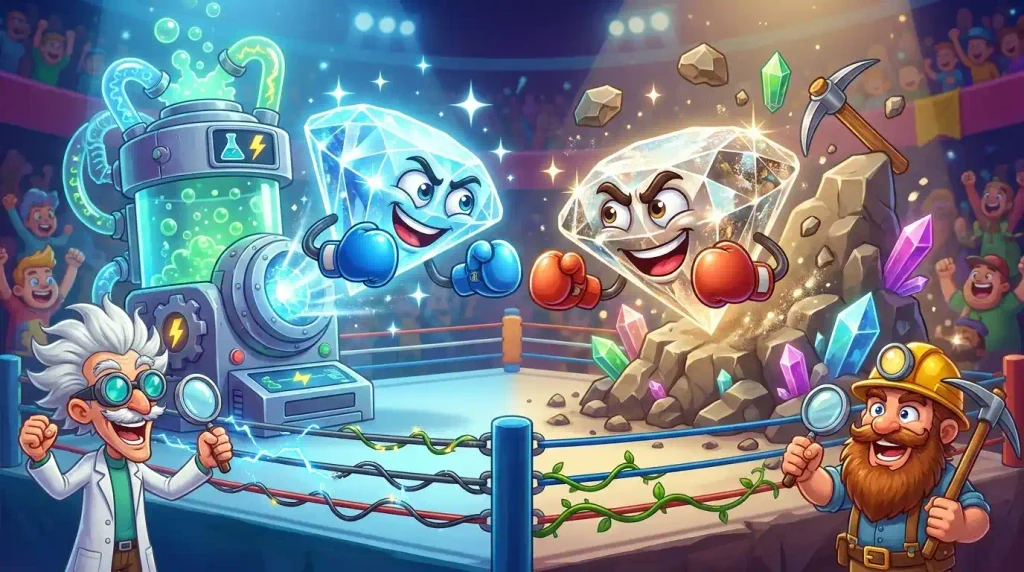
Modern technology has fundamentally altered the jewelry industry by giving us the ability to grow high-quality gems inside advanced laboratories.
How Lab-Grown Gems Are Created
Scientists use two main methods to grow gems: High Pressure High Temperature (HPHT) and Chemical Vapor Deposition (CVD). HPHT mimics the intense heat and crushing pressure found deep within Earth’s mantle.
CVD uses a small diamond seed placed in a specialized vacuum chamber filled with carbon-rich methane gas. Microwave energy breaks the gas apart, allowing carbon to slowly build up layer by layer into a flawless crystal.
Are Lab Diamonds Real?
Yes, lab-grown diamonds are 100% real diamonds in every sense of the word. They share the identical chemical composition, crystal structure, optical brilliance, and physical hardness of mined gems.
Even professional jewelers cannot tell them apart visually without specialized laboratory machinery that checks for minute atomic growth patterns.
Practical Uses of Industrial Diamonds
While most people admire gems in sparkling jewelry, over 80% of all mined diamonds are actually used for heavy industrial applications.
- Precision cutting tools for tough stone and thick glass.
- Specialized medical scalpels used during delicate eye surgeries.
- High-performance heat sinks inside microprocessors and electronics.
- Heavy-duty drill bits for deep oil, gas, and mineral exploration.
- Thermal imaging windows inside specialized high-power lasers.
How to Care for Diamond Jewelry
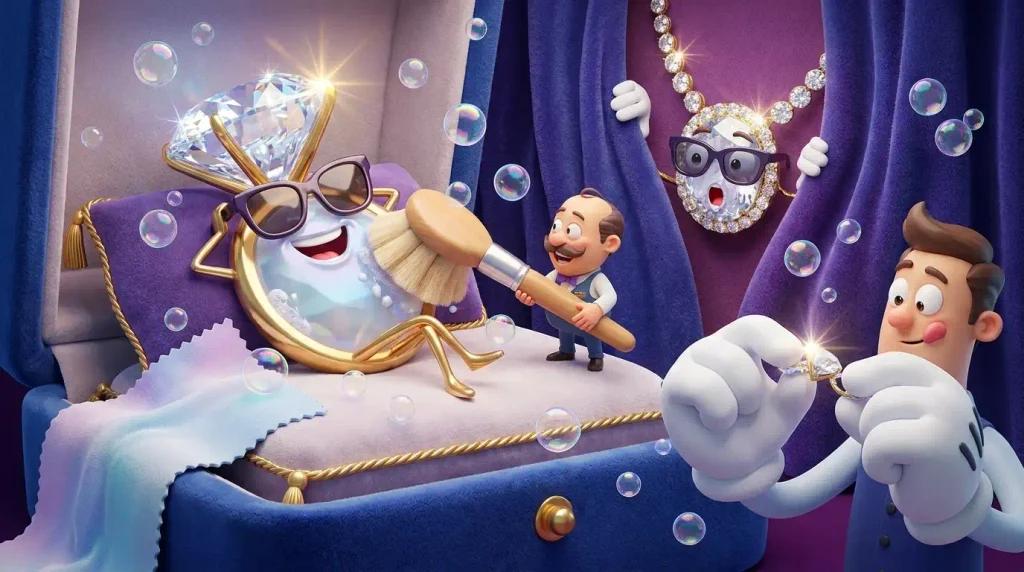
Because these stones are so valuable and durable, taking proper care of your daily jewelry ensures it continues to shine brightly for generations to come.
Cleaning Your Sparklers at Home
Dirt, body oils, and hand lotion can quickly build up behind set stones, making them look cloudy, dull, and dark. You can easily clean your jewelry right at home using warm water and mild dish soap.
Simply soak your ring for twenty minutes, gently scrub around the mounting with a soft toothbrush, rinse thoroughly under warm water, and pat dry with a clean microfiber cloth.
Safe Storage Tips
Even though diamonds are extremely hard, they can easily scratch softer gemstones like opals, pearls, and sapphires sitting nearby.
Always store your diamond rings and earrings in separate soft cloth bags or individual padded compartments inside your favorite jewelry box.
Practice Exercise
- What primary element makes up the chemical structure of a diamond?
A. Silicon
B. Carbon
C. Oxygen
D. Iron - On the Mohs Hardness Scale, what rating does a natural diamond receive?
A. 8
B. 9
C. 10
D. 12 - What gas in Neptune’s atmosphere creates conditions for diamond rain?
A. Methane
B. Helium
C. Nitrogen
D. Argon - Which ancient language gives us the word “diamond,” meaning unconquerable?
A. Latin
B. Sanskrit
C. Greek
D. Hebrew - What color is officially the rarest natural diamond hue on Earth?
A. Yellow
B. Blue
C. Green
D. Red - Where do natural diamonds form deep inside the planet Earth?
A. Oceanic Crust
B. Earth’s Mantle
C. Outer Core
D. Continental Sediment - What famous diamond is known for glowing deep red under UV light?
A. Cullinan Diamond
B. Koh-i-Noor
C. Hope Diamond
D. Regent Diamond - What element is trapped inside a diamond’s lattice structure to create blue shades?
A. Nitrogen
B. Boron
C. Hydrogen D. Copper - Approximately how old are most natural diamonds found near Earth’s surface today?
A. 1 to 3.5 million years
B. 50 to 100 million years
C. 1 to 3.5 billion years
D. 10 to 12 billion years - What percentage of all mined diamonds are used primarily for industrial tasks?
A. 20%
B. 50%
C. 80%
D. 95%
Answer Key:
- B | 2. C | 3. A | 4. C | 5. D | 6. B | 7. C | 8. B | 9. C | 10. C
FAQs
Can a diamond break if dropped?
Yes, a diamond can shatter if dropped at a specific angle onto a hard surface like tile. While diamonds excel at resisting scratches, sharp impacts along their natural cleavage planes can easily chip or crack the stone.
Is coal really turned into diamonds over time?
No, coal does not transform into diamonds. Diamonds form much deeper in the mantle from pure trapped carbon, whereas coal develops near the surface from decayed plant matter that lived hundreds of millions of years ago.
Why do some diamonds glow in the dark?
Some diamonds display fluorescence when exposed to ultraviolet rays. Trapped mineral impurities like nitrogen cause the crystal lattice to absorb invisible light and emit a temporary blue or red glow that lasts for several seconds.
How are lab diamonds different from natural ones?
Lab diamonds share the exact chemical composition and physical properties of natural ones. The only difference is that lab gems grow in high-tech facilities over weeks, while natural ones form deep underground over billions of years.
What is the largest rough diamond ever discovered?
The Cullinan Diamond is the largest gem-quality rough stone ever found. Discovered in South Africa in 1905, it weighed an astounding 3,106 carats before being cut into several famous royal gems.
Can diamonds burn in a normal fire?
Yes, diamonds can catch fire and vaporize if exposed to extreme heat. Because they consist of pure carbon, heating a diamond above 1,500 degrees Fahrenheit in open oxygen causes it to burn away into carbon dioxide.
Why are red diamonds so expensive?
Red diamonds are exceptionally rare because very few exist in human history. Their distinct color comes from rare structural distortions during formation rather than chemical impurities, driving their market value to astronomical heights.
Conclu
sion
Discovering these unique diamond fun facts reveals that these stunning stones are far more than mere sparkling decorations. From ancient deep-Earth origins to cosmic gem rains on distant outer planets, diamonds remain one of nature’s most fascinating scientific marvels.
Whether you admire them for their legendary hardness, brilliant sparkle, or colorful backstories, these timeless gems never fail to captivate our imagination. Exploring these surprising diamond fun facts proves just how special carbon crystals truly are across the entire universe.
If you enjoyed discovering these amazing gem secrets, share these diamond fun facts with your fellow rock collectors and friends today!

Ghzala Rani is the creator and writer behind Funzonest.com, a website dedicated to making everyday topics more enjoyable, interesting, and easy to understand. With a passion for engaging content, Ghzala focuses on creating helpful articles that inform, entertain, and provide readers with useful ideas and insights.
Through Funzonest.com, Ghzala Rani aims to build a friendly online space where readers can discover fresh content and explore topics presented in a simple and enjoyable way. Her writing style focuses on clarity, originality, and reader value. She is committed to publishing well-researched and engaging content that keeps visitors informed while making their time on the website enjoyable.