
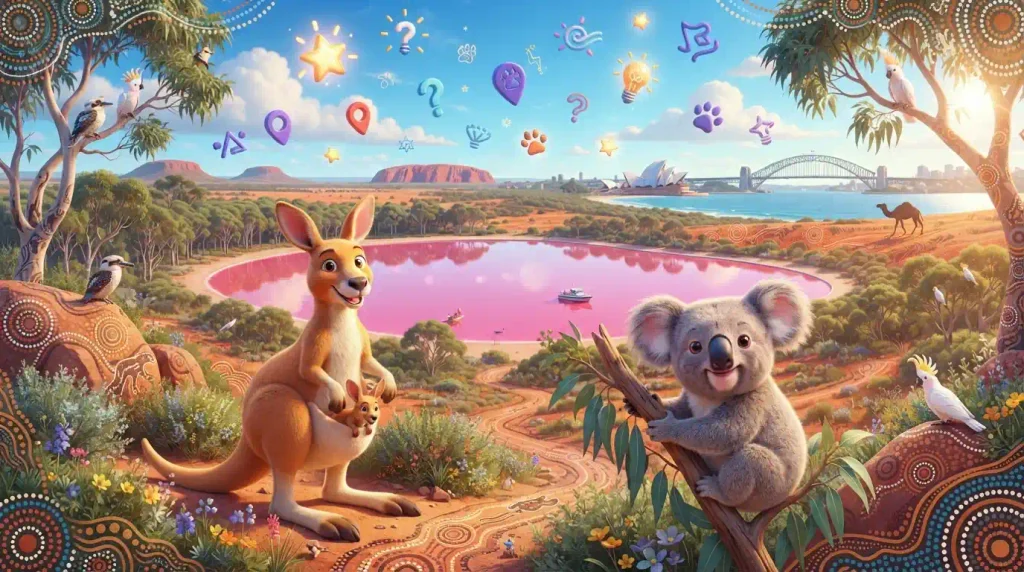
Exploring fun aussie facts reveals a land of incredible extremes, featuring cube-shaped wombat poop, millions of wild camels, and pink lakes. From the massive Great Barrier Reef visible from space to quirky slang words, Australia offers endlessly fascinating nature and culture for curious readers worldwide.
Have you ever wondered why Australia feels like an entirely different world? Discovering fun aussie facts is the absolute best way to learn about the unique nature of the Land Down Under.
From cube-shaped wombat poop to pink lakes, reading fun aussie facts will completely change how you view Australian wildlife and geography. Every single detail about this continent offers something surprising and entertaining.
Sharing these fun aussie facts with friends will make you the star of your next trivia night. Let us explore the most incredible secrets of Australia together!
Mind-Blowing Wildlife Trivia Down Under
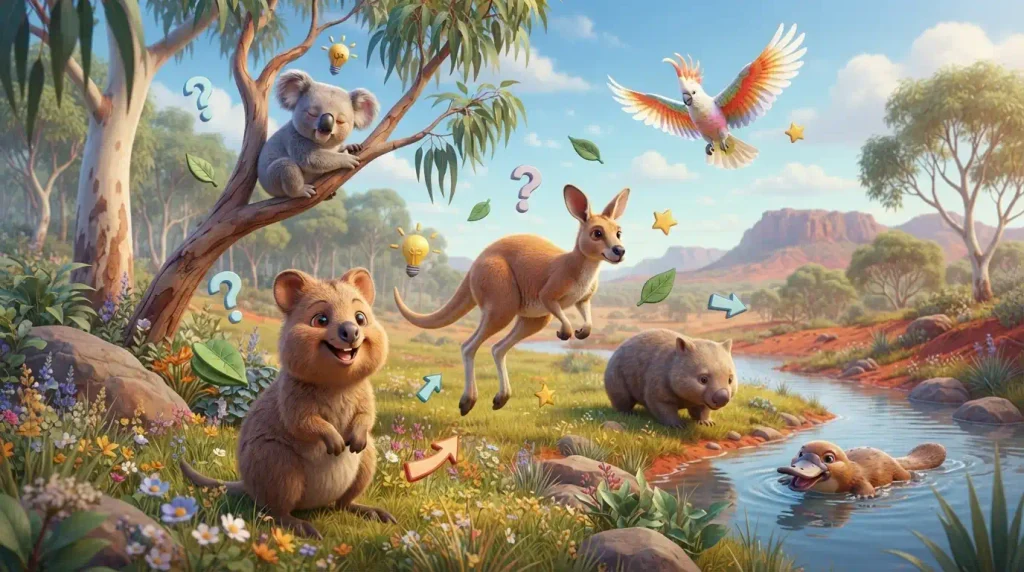
Australia is world-famous for its incredible animals, many of which exist nowhere else on Earth. Isolated for millions of years, nature took a completely unique evolutionary path here.
From bouncing marsupials to egg-laying mammals, the continent is a living laboratory of weird and wonderful creatures.
Why Wombat Poop Is Cube-Shaped
Wombats are adorable, stocky marsupials native to Australian forests and grasslands. However, their most famous biological trait is producing distinct, cube-shaped droppings.
This unusual shape prevents their territory markers from rolling off steep rocks and fallen logs. Their slow digestion process dries out the waste, compressing it into neat geometric shapes before exit.
- A single wombat can produce up to 100 poop cubes every night.
- They use these raised droppings to signal their location to other wombats.
- Scientists studied this process to understand unique methods of biological manufacturing.
Platypuses Glow Under UV Light and Lay Eggs
The platypus was already famous for having a duck bill, a beaver tail, and webbed feet. Scientists initially thought fake specimens sent to Europe were clever taxidermy hoaxes.
Researchers recently discovered that platypus fur biofluoresces, glowing a soft blue-green under ultraviolet light. They are also monotremes, meaning they lay eggs instead of giving birth to live young.
Male platypuses even sport venomous spurs on their hind legs, making them one of the few venomous mammals alive today.
Koalas Are Not Bears at All
Many people around the world call these sleepy tree-dwellers “koala bears,” but that name is completely inaccurate. Koalas are marsupials, meaning females carry their developing babies inside a protective belly pouch.
Their closest animal relatives are actually wombats, not grizzly or polar bears.
They survive on a strict diet of eucalyptus leaves, which are tough and toxic to most creatures. Because digesting these leaves takes enormous energy, koalas sleep up to twenty hours every single day.
Incredible Australian Landscapes and Nature
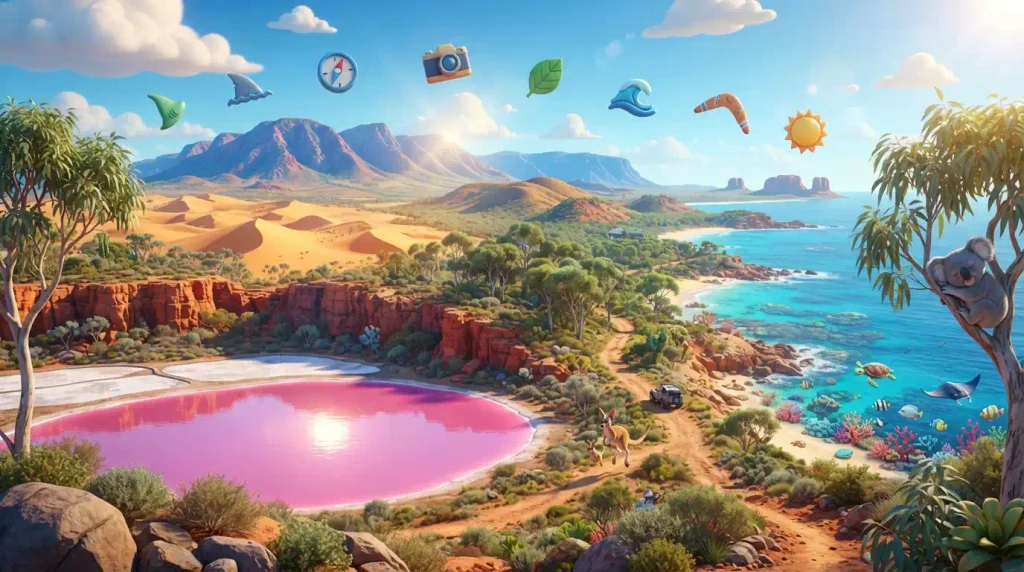
Australia is the world’s smallest continent but its sixth-largest country by land area. It spans multiple climate zones, ranging from tropical rainforests to scorching central deserts.
The sheer scale of its natural landmarks leaves visitors speechless.
The Great Barrier Reef Is Visible from Space
Stretching over two thousand kilometers along the Queensland coast, the Great Barrier Reef is the planet’s largest coral reef ecosystem. It is composed of billions of tiny living organisms called coral polyps.
The structure is so massive that astronauts can easily spot its vibrant turquoise outlines from orbit.
- It houses over 1,500 distinct species of fish.
- Six of the world’s seven species of sea turtles live here.
- It covers an area larger than Italy, Japan, or the United Kingdom.
Australia Has More Camels Than Egypt
When you picture Australian animals, camels rarely come to mind. Yet the central Australian desert contains the world’s largest herd of wild, free-roaming dromedary camels.
Afghani handlers imported thousands of camels in the nineteenth century to build railways and transport supplies across harsh deserts.
When motor vehicles replaced them, thousands were released into the wild, where their population exploded. Today, Australia even exports camels to Middle Eastern nations.
Lake Hillier: The Bright Pink Mystery
Along the southern coast of Western Australia sits Lake Hillier, a body of water that looks like bright bubblegum. Unlike other colored lakes that shift hues, this water remains vibrant pink even when scooped into a clear glass.
Scientists discovered the color comes from high salt levels combined with salt-loving algae called Dunaliella salina.
These tiny organisms produce protective red pigments that turn the entire saline lake a shocking shade of pink.
Bizarre Aussie History and Quirky Culture
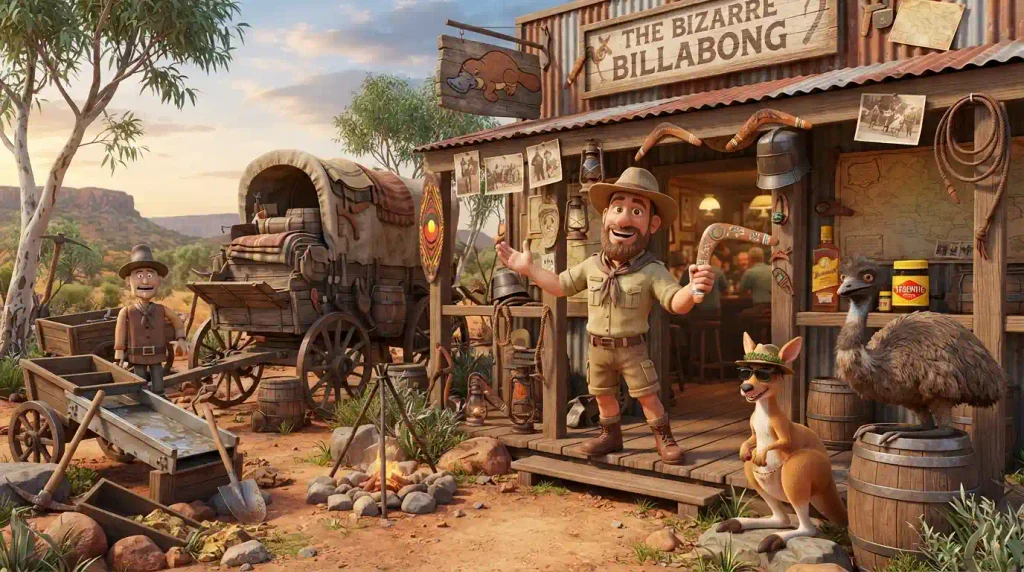
Australian culture combines relaxed humor, outdoor adventure, and a rich history stretching back tens of thousands of years.
The nation’s historical timeline features quirky events that sound more like Hollywood fiction than real life.
The Great Emu War of 1932
In 1932, ex-soldiers farming in Western Australia faced a massive invasion of over twenty thousand hungry emus. The large flightless birds were destroying vital wheat crops during difficult economic times.
The military was called in equipped with machine guns to herd and reduce the wild emu populations.
However, the emus used guerrilla-like tactics, splitting into tiny groups whenever gunfire started. The birds easily outmaneuvered the soldiers, leading the military to retreat and declaring the emus victorious.
The Missing Prime Minister and a Public Pool
In 1967, Australian Prime Minister Harold Holt went swimming at Cheviot Beach in Victoria and vanished without a trace. Despite a massive search effort, his body was never recovered.
Rather than sinking into solemn mourning, Australians responded with characteristic Aussie humor.
They named the Harold Holt Memorial Swimming Centre in Melbourne after him to honor his love for water sports.
Indigenous Culture Is the Oldest Continuous Culture on Earth
First Nations Australians have inhabited the continent for over sixty thousand years. Their rich traditions, storytelling, and land management techniques predate the Egyptian pyramids by tens of thousands of years.
They passed down crucial survival knowledge and ecological history through oral storytelling known as Songlines.
These ancestral pathways act as living maps across the vast Australian desert landscape.
Decoding Aussie Slang and Everyday Talk

Australian English is packed with colorful abbreviations, playful slang, and unique humor. Aussies love shortening words and adding an “-ie” or “-o” sound at the end.
Learning the local lingo helps you understand conversations like a true insider.
Common Aussie Words and Their Meaning
If you visit an Australian beach, you will quickly realize the locals speak a delightfully altered version of English. Understanding these basic terms keeps you from getting confused.
Here is a quick snapshot of essential vocabulary you will hear every day:
The Story Behind the Word “G’day”
“G’day” is the quintessential Australian greeting known around the world. Short for “good day,” it is used universally regardless of the time of day.
It reflects the egalitarian nature of Australian society, where everyone is treated like an equal mate.
Saying it with a warm smile instantly breaks the ice with locals anywhere in the country.
Why Vegemite Is a Cultural Icon
Vegemite is a dark brown food spread made from leftover brewers’ yeast extract combined with vegetable and spice additives. It has a salty, savory taste that leaves foreign visitors completely shocked if eaten incorrectly.
The secret to enjoying it is spreading a tiny smear over warm buttered toast.
Aussies grow up eating it, making it an iconic symbol of home and childhood nostalgia.
Unique Geography and Natural Wonders
Australia’s geography holds several world records for size, climate extremes, and biological variety. Living on the world’s driest inhabited continent shapes every aspect of daily life.
Let us look at some jaw-dropping spatial facts about this giant landmass.
Over Ninety Percent of the Population Lives Near the Coast
Vast stretches of central Australia consist of dry, hot, uninhabitable land known as the Outback. Because the interior is so harsh, major cities developed along coastal regions where water and mild weather were abundant.
Metropolitan areas like Sydney, Melbourne, Brisbane, and Perth house the vast majority of citizens.
- Australia has over 10,000 pristine beaches across its coastline.
- You could visit a new beach every single day for over twenty-seven years.
- Most residents live within fifty kilometers of an ocean shore.
Highway 1 Is the Longest National Highway in the World
If you enjoy epic road trips, Australia’s Highway 1 offers the ultimate driving challenge. This continuous network of roads completely circles the continent, joining every state capital city.
It covers approximately 14,500 kilometers of coastal scenery, tropical forests, and desolate plains.
Driving the entire highway at a normal pace takes several months of dedicated travel time.
Uluru Is Larger Underground Than Above Ground
Uluru is a giant sandstone monolith located deep inside the Northern Territory’s Red Centre. It stands over 348 meters tall above the flat desert floor, making it higher than the Eiffel Tower.
However, the visible rock formation is just the tip of a massive subterranean geological structure.
Geologists estimate the rock extends several kilometers deep into the earth’s crust.
Surprising Facts About Aussie Wildlife Safety
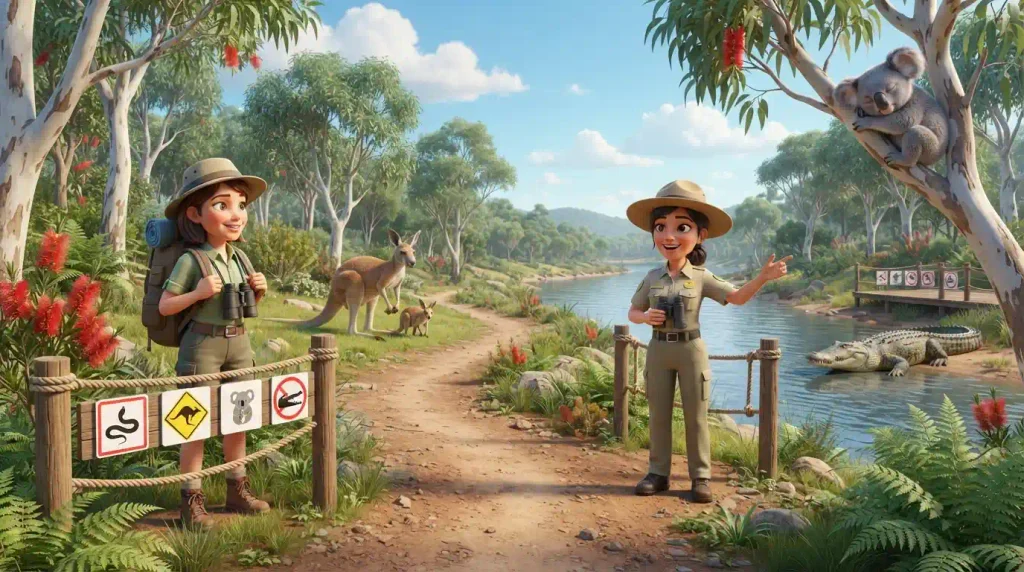
People often joke that every creature in Australia is trying to harm you. While the continent does house venomous spiders, snakes, and marine life, actual dangerous encounters are extremely rare.
Understanding safety facts helps put these scary myths into proper perspective.
Spider Myths vs. Modern Medical Reality
Australia is home to the Sydney funnel-web spider and the redback spider, both of which possess potent venom. Popular media often paints a picture of constant spider danger around every household corner.
However, antivenom programs introduced in 1981 completely changed public health safety.
No person has died from a confirmed spider bite in Australia for over forty years.
The Deadly Box Jellyfish and Irukandji
While sharks grab big news headlines, tiny marine stingers pose a much higher seasonal threat in tropical northern waters. The box jellyfish and microscopic Irukandji jellyfish drift along beaches during summer months.
Their venom causes intense pain and cardiac complications if left untreated by medical teams.
Swimmers wear full-body lycra suits or swim inside stinger nets to stay completely safe while enjoying warm waters.
Kangaroos Outnumber Humans by Millions
Kangaroos are a proud national symbol featured on the official Australian coat of arms. Their wild population fluctuates depending on rain patterns and food availability across pastures.
Current estimates suggest there are roughly fifty million kangaroos roaming the country.
With a human population of around twenty-six million, kangaroos outnumber citizens almost two to one.
Mind-Blowing Science and Space Contributions
Australia plays a vital, yet quiet, role in global scientific breakthroughs and space exploration. Its dark desert skies and clear atmospheric conditions offer ideal placement for deep space research facilities.
Inventions from Aussie labs shape how the entire modern world communicates today.
Aussies Invented Modern Wi-Fi Technology
Every time you connect your smartphone to wireless internet, you can thank Australian scientists. During the 1990s, researchers at CSIRO were studying radio waves from distant black holes.
They created a mathematical formula to clean up scrambled radio signals reflected off indoor walls.
That exact radio signal breakthrough became the foundational patent for high-speed Wi-Fi technology used globally today.
The Parkes Observatory Helped Broadcast the Moon Landing
In July 1969, Apollo 11 landed human beings on the Moon for the very first time in history. Millions of families sat glued to television sets watching Neil Armstrong take his historic steps.
The clear live video feed was received using the massive radio telescope at the Parkes Observatory in New South Wales.
Despite fierce windstorms threatening the dish structure, engineers maintained tracking to broadcast history to the world.
The Black Box Flight Recorder Origin
Aviation safety changed forever thanks to Australian scientist Dr. David Warren in the 1950s. After investigating a commercial airplane crash, he realized recording cockpit voices and flight data would solve air disasters.
He built the world’s first flight data recorder prototype to store crucial instrument readings.
Today, every commercial airplane carries these indestructible recording units to protect passengers worldwide.
Everyday Lifestyle and Fun Cultural Habits
Daily life in Australia revolves around outdoor sunshine, competitive sports, and relaxed social gatherings. Understanding these daily habits shows why Australians rank among the happiest global populations.
Here is how locals spend their free time and weekends.
The Culture of the Weekend Meat Pie
While Americans love hot dogs at baseball games, Australians feast on hot meat pies at football matches. A classic Aussie meat pie consists of minced meat and gravy encased in flaky pastry dough.
Top it with a thick dollop of tomato sauce for the authentic game-day dining experience.
Bakeries across tiny Outback towns compete fiercely for the title of best regional pie maker.
School Kids Wear compulsory Broad-Brimmed Hats
Because Australia sits under a thin section of the ozone layer, sun safety is taken extremely seriously. Schools enforce a strict policy known as “No Hat, No Play” during outdoor recess breaks.
If a student forgets their broad-brimmed hat, they must sit under shaded patio areas.
This habit instills life-long sun protection behaviors in children from an early age.
Australian Football (AFL) Is Unlike Any Other Sport
Australian Rules Football, or AFL, is a high-speed contact sport played on massive oval cricket fields. Eighteen players per team kick, handball, and run with an oval ball without wearing heavy padding.
Players leap high onto opponents’ shoulders to catch long kicks, an action called a “mark.”
The sport draws massive stadium crowds that fill venues with electric energy every winter weekend.
Iconic Inventions You Did Not Know Were Australian

Australian ingenuity stretches far beyond agricultural tools and space research. Simple everyday household items were dreamed up by Aussie inventors looking to solve practical problems.
Here are a few surprising items created Down Under.
The Clothesline Hoist in Every Back Yard
The Hills Hoist is a rotary clothesline featuring a height-adjustable hoist mechanism designed in Adelaide. Invented by Lance Hill in 1945, it allowed families to dry laundry efficiently in sunny backyards.
It quickly became an iconic symbol of suburban Australian home life.
Kids often hung from the metal arms to swing around like a playground merry-go-round.
Plastic Banknotes with High-Tech Security
Australia was the first nation to develop and issue polymer plastic banknotes to replace paper currency. Developed by CSIRO in partnership with the Reserve Bank, plastic notes were introduced in 1988.
They last four times longer than traditional paper money and resist dirt and moisture.
They also allow intricate clear window features that make counterfeiting virtually impossible.
Dual-Flush Toilets Save Billions of Gallons of Water
Given the continent’s frequent droughts, conserving household water is a top environmental priority. In 1980, inventor Bruce Thompson created a dual-flush toilet system featuring two separate buttons.
One button releases a small flush for liquid waste, while the second uses a full flush for solids.
This simple design is now standard across green construction projects worldwide.
Practice Exercise
Test your knowledge of these incredible facts with these 10 multiple-choice questions.
- What unique geometric shape is wombat poop?
A. Sphere
B. Cube
C. Cylinder
D. Triangle - Which color does platypus fur glow under ultraviolet light?
A. Bright red
B. Soft blue-green
C. Neon yellow
D. Deep purple - What main type of animal is a koala?
A. Bear
B. Rodent
C. Marsupial
D. Primate - What natural wonder in Australia can be seen from space?
A. Uluru
B. Lake Hillier
C. The Great Barrier Reef
D. The Blue Mountains - Which animal defeated the Australian military in the 1932 Emu War?
A. Kangaroos
B. Emus
C. Camels
D. Dingoes - What natural ingredient gives Lake Hillier its permanent pink color?
A. Chemical spills
B. Salt-loving algae
C. Volcanic ash
D. Coral dust - What percentage of the Australian population lives near coastal regions?
A. About 25%
B. About 50%
C. About 70%
D. Over 90% - What Australian invention forms the base technology for modern Wi-Fi networks?
A. Radio signal processing formula
B. Fiber optic glass
C. Satellite dishes
D. Computer microchips - Why was the dual-flush toilet invented in Australia?
A. To save manufacturing costs
B. To conserve household water
C. To prevent pipe blockages
D. To look modern in homes - What shape is the field used for Australian Rules Football (AFL)?
A. Square
B. Rectangle
C. Oval
D. Triangle
Answer Key
- B | 2. B | 3. C | 4. C | 5. B | 6. B | 7. D | 8. A | 9. B | 10. C
FAQs
What are three fun aussie facts about animals?
Wombats produce cube-shaped poop to mark territory without waste rolling away. Platypuses glow a soft blue-green color under ultraviolet light, and koalas are marsupials, not bears. These unique evolutionary traits keep Australian wildlife endlessly surprising for researchers.
Why is Australia home to so many wild camels?
Camels were imported from the Middle East in the nineteenth century to assist with desert transport and construction. When cars replaced them, thousands were released into the wild outback. With ideal desert conditions, their population grew into the world’s largest herd.
Is the Great Barrier Reef really visible from space?
Yes, the Great Barrier Reef is so massive that astronauts easily spot its turquoise outlines from orbit. It stretches over two thousand kilometers along the coast of Queensland and consists of billions of living coral polyps.
Why do Australians call flip-flops “thongs”?
Australians use the slang word “thongs” to refer strictly to rubber flip-flop sandals worn on the beach. It is a harmless casual term used across households, beach resorts, and stores throughout the summer months.
How safe is it to travel in Australia despite dangerous animals?
Traveling in Australia is remarkably safe for tourists when basic safety rules are followed. Modern antivenom programs have prevented spider bite deaths since 1981, and lifeguards protect popular swimming beaches across coastal towns.
What is the origin of the word “G’day”?
“G’day” is a shortened form of the traditional English greeting “good day” used across Australian communities. It represents the warm, casual, and friendly culture that welcomes people as equals regardless of status.
Conclusion
Exploring top fun aussie facts reveals the extraordinary wildlife, landscapes, culture, and history that make Australia so fascinating. Learning these details helps you appreciate the unique features that set the country apart.
Whenever you discover new fun aussie facts, you can uncover surprising details about pink lakes, wild camels, Aboriginal culture, and remarkable Australian inventions. These interesting facts offer an enjoyable way to expand your knowledge of the Land Down Under.
Keep sharing these engaging fun aussie facts with friends and family, continue exploring Australia’s fascinating trivia, and enjoy discovering more about this remarkable country!

Ghzala Rani is the creator and writer behind Funzonest.com, a website dedicated to making everyday topics more enjoyable, interesting, and easy to understand. With a passion for engaging content, Ghzala focuses on creating helpful articles that inform, entertain, and provide readers with useful ideas and insights.
Through Funzonest.com, Ghzala Rani aims to build a friendly online space where readers can discover fresh content and explore topics presented in a simple and enjoyable way. Her writing style focuses on clarity, originality, and reader value. She is committed to publishing well-researched and engaging content that keeps visitors informed while making their time on the website enjoyable.