Fun art games are interactive creative activities, party challenges, and digital prompts designed to make drawing, painting, and visual storytelling playful and low-pressure. Popular examples include Exquisite Corpse, blind drawing challenges, speed Pictionary variations, collaborative canvas passing, and digital drawing party apps that encourage laughter and spontaneous artistic expression.
Have you ever stared at a blank piece of paper and felt completely stuck on what to draw? Introducing fun art games into your routine is the easiest way to break creative block and turn drawing into pure play.
Instead of worrying about making a masterpiece, fun art games shift your focus to enjoying the process. You get to laugh at silly doodles while connecting with friends, family, or online playmates.
Whether you are looking for party icebreakers or cozy solo drawing prompts, exploring fun art games will revive your creative energy. Join us for a tour of classic party games, digital sketching tools, and practical ways to host your own art game night.
Why Playful Creative Challenges Boost Imagination
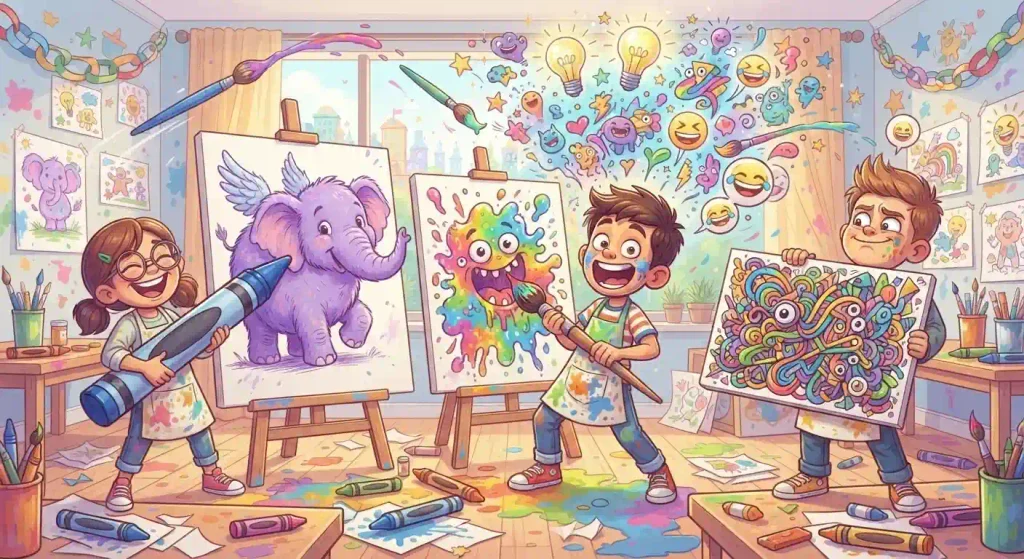
Most people stop drawing as adults because they fear making mistakes or producing ugly art. Creative games remove that pressure by adding silly rules, time limits, and unexpected twists that prioritize fun over perfection.
When you play, your brain relaxes, allowing unexpected ideas to pop up without self-criticism. This playful mindset helps build confidence, sharpens visual problem-solving skills, and makes creative expression feel natural again.
Shared drawing activities also act as fantastic social bridges. They bring together people of all skill levels, ensuring that a complete beginner has just as much fun as a seasoned illustrator.
The Psychology of Low-Pressure Creativity
When you draw under strict rules or tight time constraints, your inner critic simply does not have time to speak up. The brain shifts focus from perfectionism to fast decision-making, which releases tension and encourages spontaneous mark-making.
This shift triggers dopamine release, making the creative act feel deeply rewarding regardless of the final visual result. In fact, strange or distorted drawings often generate the biggest laughs and happiest memories.
Lowering expectations allows players to embrace happy accidents. A misplaced line or funny squiggle quickly turns into the centerpiece of a brand-new character.
What Makes an Art Game Truly Engaging
Great creative prompts balance clear constraints with total artistic freedom. If a game is too strict, players feel stressed; if it is too open, they freeze up wondering where to begin.
- Simple Setup: Requires basic supplies like standard paper, pencils, markers, or a simple phone app.
- alternative
- High Variety: Random prompts, secret themes, or changing rules that keep every single round fresh.
- Shared Results: A clear reveal moment at the end where everyone shares their work and laughs together.
Classic Physical Art Games for Parties and Family Nights
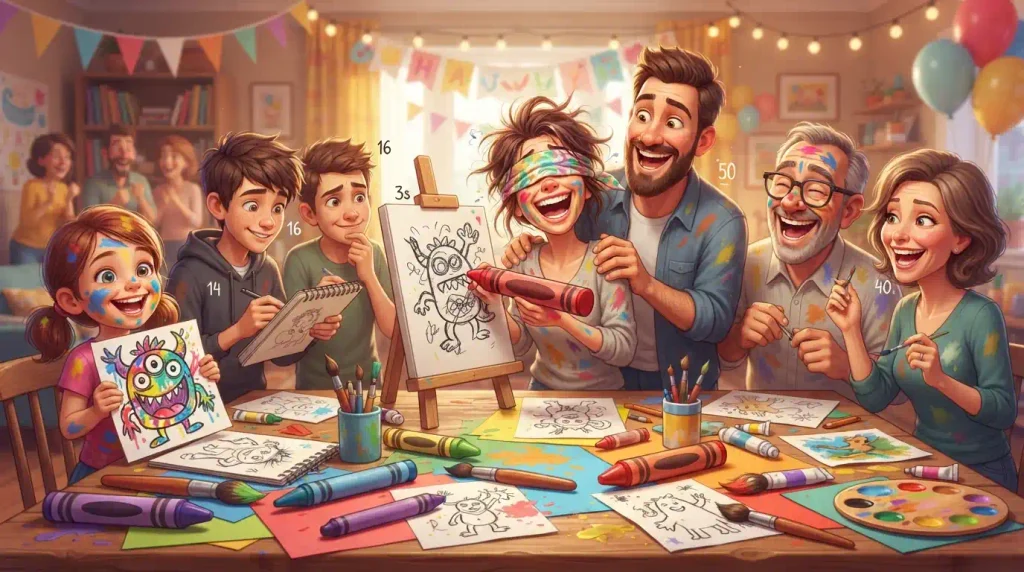
You do not need fancy supplies or digital screens to host an amazing drawing session. Classic pen-and-paper party games have entertained families and artistic circles for generations because their mechanics are simple and hilarious.
Here is a breakdown of time-tested physical drawing games you can play anytime at home.
Exquisite Corpse: The Surrealist Folding Game
Invented by Surrealist artists in the 1920s, Exquisite Corpse is the ultimate collaborative drawing exercise. Players fold a sheet of paper into three or four hidden sections and take turns drawing parts of a character without seeing the other sections.
The first person draws the head, folds the paper over to hide their work while leaving small neck guidelines, and passes it along. The next person draws the torso, and the final player draws the legs and feet.
Unfolding the paper at the end reveals a bizarre, hybrid monster that nobody could have planned on their own. It is a fantastic game for breaking the ice and getting instant group laughs.
Blind Contour and Non-Dominant Hand Challenges
Blind contour drawing forces you to look only at your subject, such as a friend’s face, without ever looking down at your paper. You must keep your pencil moving constantly while tracking your eyes across the contours of their features.
Drawing with your non-dominant hand creates a similar effect by stripping away your fine motor control. The resulting lines are wobbly, chaotic, and charmingly distorted.
These challenges teach you to observe real details rather than relying on mental shortcuts. Plus, the final portraits look like quirky modern art pieces ready for the fridge.
Pass the Canvas (Speed Cadence Drawing)
Pass the Canvas sets a fast-paced timer where every player starts drawing their own picture on a blank page. Every sixty seconds, a bell rings, and everyone must pass their paper to the person sitting on their right.
You must immediately continue the drawing your neighbor started, adding new details, colors, or background elements before the next bell. After four or five rotations, the original owner gets their paper back to see how their idea evolved.
This game teaches players to let go of ownership over their work and embrace surprise contributions from friends.
Telephone Pictionary
Combining classic whispers with quick sketches creates Telephone Pictionary, one of the funniest group games available. Each player writes a secret phrase on a stack of index cards and passes it to their neighbor.
The neighbor reads the phrase, moves that card to the back, and draws a picture representing the phrase on the next card. The third player looks only at the drawing, writes down what they think it means, and passes it along.
By the time the stack travels around the circle, “A cat driving a racecar” often transforms into “A giant potato wearing a helmet.”
Modern Digital Art Games and Interactive Apps
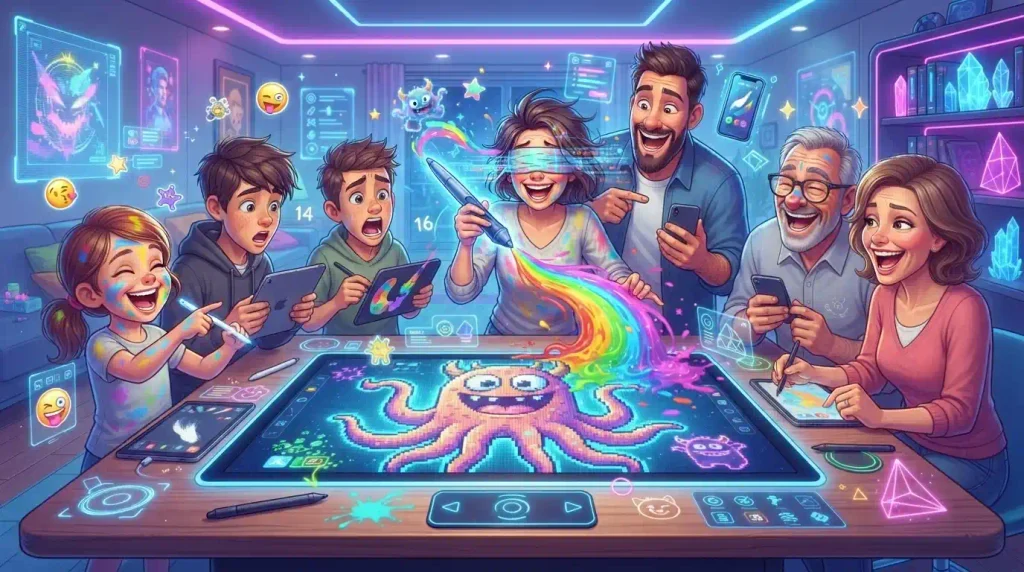
Technology has brought visual party games to global audiences, allowing friends to play together on smartphones, tablets, and computers. Digital tools remove the need for physical cleanup while introducing fast automated scoring and multiplayer lobbies.
Exploring virtual drawing platforms opens up endless possibilities for remote game nights and casual phone fun.
Multiplayer Drawing and Guessing Platforms
Online drawing lounges allow players to join public rooms or private friend lobbies to play fast-paced sketch-and-guess games. One player gets a secret word to draw on a digital canvas using a mouse or touchscreen, while others type their guesses into a chat box.
- Gartic Phone: A digital version of Telephone Pictionary that records hilarious animated replays of how drawings transform over time.
- Skribbl.io: A fast, browser-based guessing game ideal for quick office breaks or casual streamer events.
- Jackbox Drawful: A couch-co-op party game where players draw bizarre prompts on their personal phones and vote on funny fake titles.
Virtual Sculpting and 3D Sandbox Games
For players who prefer spatial creativity over 2D sketching, modern 3D building games offer rich digital playgrounds. You can sculpt landscapes, build architecture, or color complex three-dimensional models alongside friends in real time.
Virtual reality painting applications take this a step further by letting you step inside your artwork. You can draw glowing lines of light in mid-air, walking around your creations as if they were physical sculptures.
Digital sandboxes are ideal for players who find traditional drawing intimidating but love constructing worlds block by block.
Comparing Popular Art Game Categories
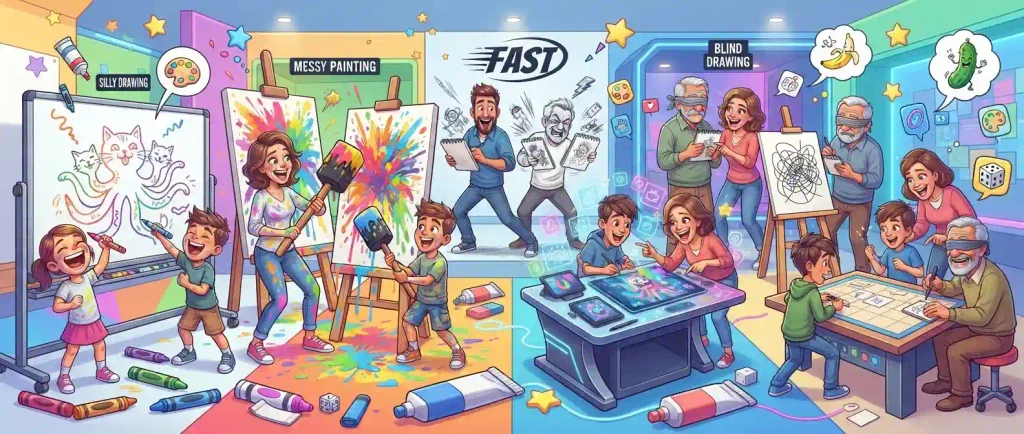
Art games come in various styles, each offering a unique way to spark creativity, encourage teamwork, and bring laughter to your gatherings. Whether you prefer quick physical sketching on paper or interactive online sessions with distant friends, understanding the differences between these game categories helps you choose the perfect activity for your group’s dynamic.
Paper-Based Collaborative Games
Traditional paper-and-pencil games like Exquisite Corpse and Telephone Pictionary are ideal for classic in-person game nights. They require minimal setup just basic sheets of paper, markers, and a tabletop making them accessible to everyone. The main strength of paper-based games lies in their tangible, hands-on nature and the hilarious, physical “unfolding” moments when revealing multi-player drawings at the end of a round.
Fast-Paced Speed and Blind Drawing Challenges
Speed and constraint-based games, such as blind contour drawing or non-dominant hand showdowns, focus on high energy and immediate action. By imposing strict time limits or restricting visual feedback, these games strip away fine motor control and eliminate perfectionism instantly. They work exceptionally well as icebreakers because they force players of all skill levels onto an equal, delightfully clumsy playing field.
Digital and Hybrid Multiplayer Art Platforms
Online platforms like Gartic Phone and Quick Draw bring creative art games into the digital era, making them perfect for remote hangouts and multi-device play. Digital games automatically manage round timers, prompt rotations, and scorekeeping, taking the stress off the host. Their standout feature is the ability to generate animated replays and downloadable GIFs, allowing players to easily save and share their funniest visual transformations across social media and group chats.
How to Host an Unforgettable Art Game Night
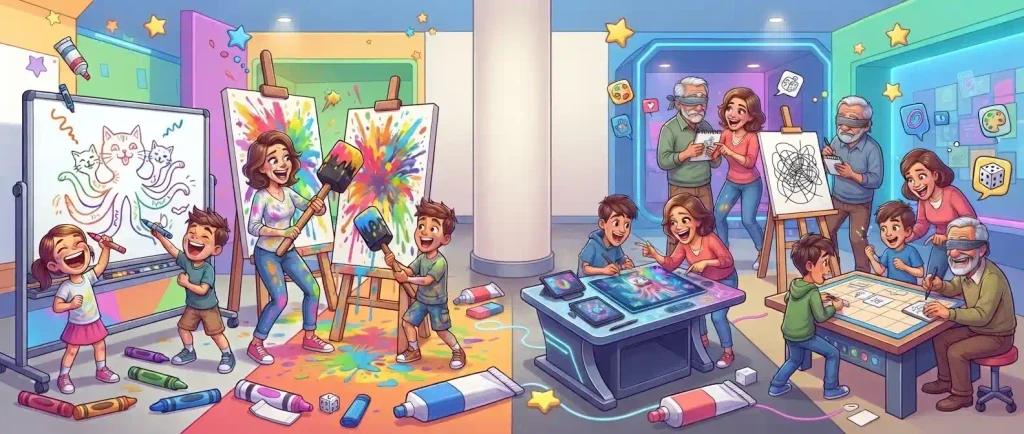
Organizing a creative game night is a refreshing alternative to traditional board game sessions or movie streaming. With simple planning, you can set up an inviting atmosphere that encourages everyone to relax and play freely.
Following a clear structure keeps the energy moving without making the night feel overly rigid.
Phase 1: Set Up an Unintimidating Workspace
Clear your kitchen table or living room coffee table, covering it with a large roll of inexpensive butcher paper. Scatter plenty of markers, crayons, colored pencils, and fine-line pens across the middle so everyone has easy access.
Using paper tablecloths immediately signals to guests that messing up is allowed and messiness is part of the fun. People can doodle right on the tablecloth while waiting for their turn in official games.
Phase 2: Start with Warm-Up Icebreakers
Begin the evening with simple, zero-pressure warm-up exercises like non-dominant hand portraits or quick scribble transformations. A scribble transformation involves drawing a random squiggle on paper and giving your partner thirty seconds to turn it into a recognizable object.
Warm-up games break the ice quickly, helping guests drop their self-consciousness before jumping into main events.
Phase 3: Move to Structured Team Games
Once everyone is relaxed, transition to structured team games like Exquisite Corpse or Telephone Pictionary. Rotate teams after a few rounds so guests have opportunities to collaborate with different people throughout the evening.
Keep a casual background playlist of upbeat instrumental music running to prevent silent awkward pauses while players focus on drawing.
Phase 4: Create an End-of-Night Gallery Wall
As games finish, use painter’s tape to display the night’s fun artwork along a prominent wall or refrigerator. Give guests small sticky notes so they can write funny award titles like “Most Distracting Haircut” or “Best Monster Design.”
Celebrating every drawing creates a positive closing memory, sending guests home with shared stories and smiles.
Clever Prompts to Spark Creative Thinking
When coming up with your own drawing challenges, selecting the right prompt keeps players engaged and entertained. Great prompts combine ordinary objects with unexpected contexts or emotions.
Mash-Up Character Prompts
Combining two completely different concepts forces your brain to invent original visual solutions instantly.
- Animal plus Appliance: Draw a penguin that is also a working toaster.
- Historical Figure plus Modern Hobby: Sketch an ancient Egyptian pharaoh learning how to skateboard.
- Food plus Profession: Illustrate a slice of pepperoni pizza working as a tough detective.
- Mythical Creature plus Job: Create a dragon trying to bake delicate cupcakes in a bakery.
Absurd Scenario Prompts
Setting up ridiculous situations gives players total freedom to stretch their imaginative muscles.
- Unusual Transportation: Draw a family taking a road trip on the back of a giant squirrel.
- Alien Encounters: Sketch an alien visiting Earth and falling in love with a garden gnome.
- Underwater Life: Illustrate a fish holding a fancy high-tea party at the bottom of the ocean.
- Microscopic Adventures: Draw tiny people exploring a mountain made out of a giant chocolate chip cookie.
Practice Exercise
Test your knowledge on game mechanics, party setups, and collaborative art concepts!
- What is the main benefit of playing low-pressure drawing games?
A. It guarantees you will sell your art to high-end galleries
B. It reduces perfectionism and builds creative confidence
C. It teaches you how to memorize complex mathematical formulas
D. It replaces the need to ever practice drawing fundamentals - Who originally invented the collaborative folding game known as Exquisite Corpse?
A. Renaissance painters in Italy
B. Surrealist artists in the 1920s
C. Video game developers in the 1990s
D. Graphic designers in ancient Greece - What constraint makes blind contour drawing so entertaining and effective?
A. You must draw using your feet instead of your hands
B. You cannot look at your paper while drawing the subject
C. You are only allowed to use white crayons on white paper
D. You must finish your entire drawing in under two seconds - How does the game “Pass the Canvas” encourage creative growth?
A. It forces players to strictly follow written legal instructions
B. It teaches players to let go of ownership and adapt to unexpected changes
C. It demands that every participant paint the same portrait
D. It awards points based on who uses the most expensive paint brand - What happens during a typical game of Telephone Pictionary?
A. Players take turns alternating between drawing pictures and guessing written prompts
B. Players talk on actual landline phones while solving math equations
C. One player paints a mural while everyone else sleeps
D. Everyone draws silently without ever sharing their papers - Which digital game features animated replays showing how drawings morph over multiple turns?
A. Chess online
B. Gartic Phone
C. Standard Solitaire
D. Virtual Sudoku - Why is covering your game table with butcher paper a smart setup strategy?
A. It prevents table lamps from casting light on the floor
B. It lowers intimidation by allowing guests to doodle freely anywhere
C. It makes the room pitch black for ghost story telling
D. It is mandatory under international game hosting rules
B A B C A B A
FAQs
Do I need to be good at drawing to enjoy art games?
No, being bad at drawing often makes these games even funnier and more entertaining for everyone. The goal of creative games is laughter, fast thinking, and social bonding rather than technical artistic perfection.
What basic supplies do I need to host a home game night?
All you need is plain printer paper, some cheap pencils, colored markers, and a simple kitchen timer. Using a butcher paper tablecloth is an extra budget-friendly touch that makes cleanup effortless.
Can art games help professional artists overcome creative blocks?
Yes, playing structured drawing games forces your brain out of rigid thinking patterns and resets your perspective. Breaking routine constraints allows fresh visual ideas to surface naturally without professional stress or client expectations.
What are the best digital art games for remote friends?
Gartic Phone, Skribbl.io, and Jackbox Drawful are fantastic choices for remote friend groups playing over video calls. They run smoothly in standard web browsers or mobile devices without requiring expensive gaming hardware.
How long should an individual drawing round last during party games?
Keep drawing rounds short, typically between sixty seconds and three minutes depending on the specific rules. Fast time limits keep energy high, prevent overthinking, and ensure you can play multiple rounds in one evening.
Are creative drawing games suitable for young children?
Absolutely, kids naturally love drawing games because they excel at imaginative play without feeling self-conscious. Games like scribble transformations and Exquisite Corpse are wonderful activities for family game nights with young children.
Conclusion
Making time for fun art games is one of the most rewarding ways to unlock your imagination, relieve stress, and share genuine laughs with the people around you. Stepping away from perfectionism allows you to discover the joy of spontaneous drawing all over again.
Remember to keep your game setups simple, mix physical paper challenges with clever digital apps, and celebrate every silly creation that comes off the page. The goal is always the fun memories you build along the way.
Gather your markers, invite a few friends over, and try your first round of fun art games tonight. You will be amazed at how quickly a blank page turns into non-stop entertainment!

Ghzala Rani is the creator and writer behind Funzonest.com, a website dedicated to making everyday topics more enjoyable, interesting, and easy to understand. With a passion for engaging content, Ghzala focuses on creating helpful articles that inform, entertain, and provide readers with useful ideas and insights.
Through Funzonest.com, Ghzala Rani aims to build a friendly online space where readers can discover fresh content and explore topics presented in a simple and enjoyable way. Her writing style focuses on clarity, originality, and reader value. She is committed to publishing well-researched and engaging content that keeps visitors informed while making their time on the website enjoyable.