
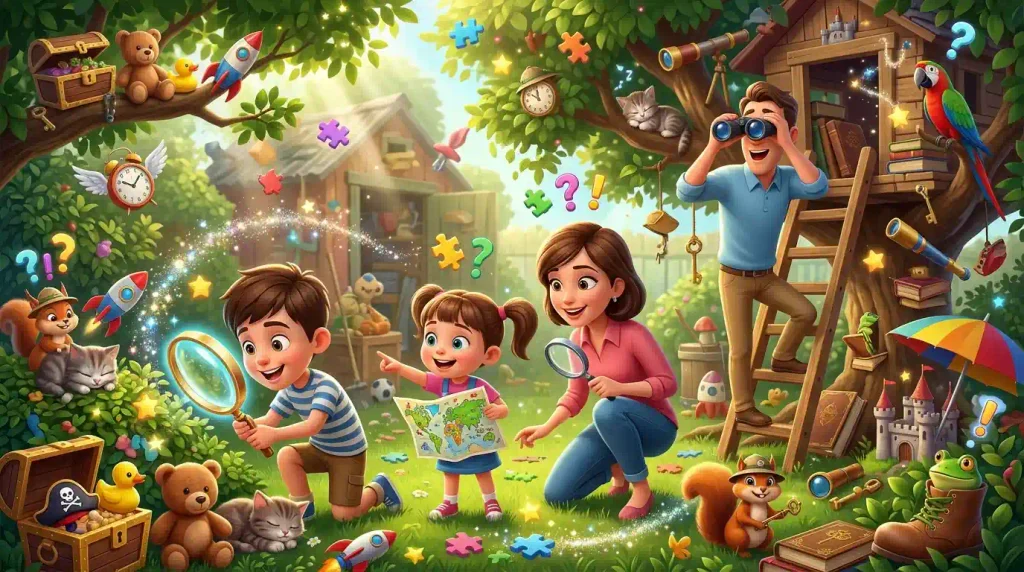
A fun & find game is an engaging visual puzzle where players search for hidden objects, symbols, or differences within detailed illustrations or real-world locations, helping to improve mental focus, visual perception, and problem-solving skills across all age groups.
Have you ever stared at a crowded picture page for minutes, only to burst out laughing when you finally spot the hidden teacup tucked inside a tree branch? Playing a fun & find puzzle is one of the most satisfying ways to give your brain a delightful workout.
Whether you enjoy classic picture books, digital mobile apps, or physical scavenger hunts, exploring a fun & find activity brings instant joy to your daily routine. Engaging with a fun & find challenge sharpens your observation skills while delivering hours of peaceful, screen-free or interactive entertainment.
Let us explore the origins, mental benefits, winning strategies, and creative game variations that make searching for hidden treasures so irresistible!
What Are Fun & Find Puzzles and Why Do We Love Them?

Search-and-find games are visual puzzles that challenge you to locate specific items hidden within a busy scene. Designers deliberately use colors, shadows, and clever angles to disguise everyday objects in unexpected places.
People of all ages naturally love the thrill of discovery. Finding a cleverly hidden item releases a quick burst of dopamine, the brain chemical responsible for feelings of reward and accomplishment.
Unlike high-stress action games that demand fast reflexes, search games let you play at your own comfortable pace. This unique balance of mental stimulation and casual relaxation makes them a favorite pastime worldwide.
The Human Psychology Behind the Thrill of Discovery
Our brains are hardwired to recognize familiar shapes, patterns, and outlines in our environment. When an image breaks expected visual rules, your mind works harder to make sense of what you see.
Spotting the hidden item satisfies your natural visual curiosity. This mental click creates a sense of mastery and satisfaction that keeps you hunting for the next challenge.
How Search Games Train Your Visual Attention
Regularly playing visual search games strengthens your ability to focus on specific details while filtering out distracting visual noise. Eye specialists call this visual discrimination and selective attention.
Developing strong visual perception helps kids read faster and aids adults in noticing small details during daily work tasks. It acts like a gym workout for your eyes and brain.
Why All Age Groups Enjoy Hidden Object Challenges
Visual puzzles transcend language barriers, age gaps, and technical skill requirements. A young child, a busy parent, and a grandparent can sit together around the same book and participate equally.
Shared searching builds family connection without the pressure of strict competition. Everyone gets to celebrate together whenever someone shouts out a successful discovery.
The Fascinating Evolution of Hidden Object Games

Searching for hidden items has a rich history that bridges physical print media and cutting-edge digital experiences. Knowing where these games originated helps us better appreciate modern puzzle design.
From classic magazine pages to virtual reality environments, visual searching keeps adapting to modern technology.
From Print Illustrated Books to Magazine Features
The genre gained massive global popularity in the mid-twentieth century through illustrated storybooks and children’s magazines. Artists spent hundreds of hours drawing complex scenes by hand using fine ink and watercolors.
Famous series like “Where’s Wally?” (Where’s Waldo?) and “I Spy” turned visual hunting into a worldwide cultural phenomenon. Millions of readers eagerly flipped pages to test their observational skills.
The Rise of Digital Hidden Object PC Games
During the late 1990s and early 2000s, video game developers brought search puzzles to home computers. These early digital titles added narrative storylines, mystery plots, and atmospheric background music.
Players explored haunted mansions, ancient ruins, and detective crime scenes to gather hidden clues. Adding a story gave visual searching a clear purpose and dramatic tension.
Modern Mobile Apps and Interactive Virtual Worlds
Today, mobile smartphones and tablets make search games accessible anywhere at any time. Touchscreen controls allow you to zoom in smoothly on intricate artwork and tap items instantly.
Modern developers add dynamic animations, moving background elements, and community leaderboards. You can solve a quick three-minute search puzzle while waiting in line or commuting on a train.
Different Types of Search-and-Find Games You Can Play

Visual search games come in many different formats, catering to various tastes and skill levels. Exploring different variations keeps your puzzle time fresh and exciting.
Here are the most popular styles of search games available today.
Classic Hidden Object Scenes
In classic hidden object scenes, you are given a written list or picture bar of items to locate within a detailed illustration. The items remain stationary while you scan the image line by line.
These scenes often feature themes like cluttered antique shops, overgrown gardens, or busy city markets. They test your patience and systematic scanning abilities.
Spot the Difference Challenges
Spot the difference games present two nearly identical images side by side. Your goal is to identify a set number of subtle variations between the two pictures.
- A missing button on a character’s jacket
- A slightly altered color on a background building
- An extra cloud added to the skyline
- A flipped object or mirrored pattern
Physical Scavenger Hunts and Geocaching
If you prefer outdoor movement, physical scavenger hunts bring search puzzles into the real world. Players use written clues, maps, or GPS coordinates to find hidden containers called geocaches in parks and cities.
Real-world hunting combines physical exercise with environmental awareness. It turns an ordinary walk in the neighborhood into a thrilling real-life treasure hunt.
Proven Strategies to Find Hidden Objects Faster
Stuck on a tricky scene with only one item left to find? Instead of staring aimlessly at the center of the screen, using systematic visual techniques can help you spot hidden items quickly.
Professional puzzle solvers rely on specific scanning habits to overcome visual tricks and illusions.
Master the Grid Scanning Technique
Instead of letting your eyes jump randomly around a chaotic picture, divide the image mentally into four equal quadrants. Focus on one square at a time, moving your eyes left to right like reading a book.
Grid scanning prevents your eyes from missing corner areas where artists frequently hide small items. It brings order and discipline to complex illustrations.
Look for Negative Space and Unnatural Outlines
Designers often disguise objects by aligning their edges with background scenery, such as blending a banana into a crescent moon. Look closely at the negative space around main characters and large structures.
Search for outlines that look slightly out of place or curves that do not match natural surroundings. An unnatural edge usually reveals a hidden item.
Reverse Your Focus by Zooming In and Out
When playing on digital devices, constantly switching your perspective prevents visual fatigue. Zoom in close to inspect tiny texture details, then zoom out to view the whole composition.
Stepping back helps you see larger patterns and silhouettes that are invisible up close. Toggling your focal distance reveals hidden details instantly.
The Brain-Boosting Health Benefits of Regular Play
Playing visual search games offers remarkable cognitive and emotional perks backed by educational research. Integrating short puzzle sessions into your week supports long-term brain wellness.
Here is how spending time with search puzzles enhances your daily health and focus.
Improving Working Memory and Visual Recall
Holding a list of target items in your mind while scanning a busy scene exercises your short-term working memory. Your brain continuously compares target shapes against hundreds of visual signals.
This active mental exercise strengthens neural pathways associated with recall and information processing. Over time, your brain retrieves visual information faster and more accurately.
Enhancing Spatial Awareness and Pattern Recognition
Spatial awareness is your ability to understand how objects relate to one another in physical space. Search puzzles require you to mentally rotate shapes and evaluate dimensions to spot concealed items.
Practicing spatial reasoning improves your ability to read maps, pack luggage efficiently, and navigate unfamiliar places easily. It is an essential skill for everyday life.
Promoting Mindfulness and Stress Relief
Focusing fully on a gentle visual puzzle grounds your mind in the present moment. This singular focus interrupts looping thoughts and worries about work or daily responsibilities.
Because search games lack harsh time limits or punitive penalties, they induce a state of relaxed mental flow. Ten minutes of visual searching leaves you feeling calm and refreshed.
How to Create Your Own Search Games at Home

You do not need professional illustration software to build fun search games for your family or classroom. Designing custom visual puzzles is a delightful creative project that brings people together.
Here are simple, low-cost ways to build memorable search activities from scratch.
Building a Physical Rice Bin Sensory Search
A sensory rice bin is a fantastic hands-on activity for young children and toddlers. Fill a plastic storage tub with dried white rice or colorful beans, and bury small plastic toys inside.
Hand your child a list of picture cards depicting the buried items. Kids use their hands, scoops, or magnifying glasses to dig through the rice and find every treasure.
Designing a Photo-Based Household Scavenger Hunt
Take close-up photographs of unusual textures or small details around your home, such as the pattern on a rug or a door hinge. Print the photos or load them onto a tablet screen.
Challenge family members to match each close-up photograph to its exact location in the house. This game encourages people to look at everyday living spaces with fresh, curious eyes.
Drawing Custom Hidden Object Pages
If you enjoy drawing, create your own line-art search pages using black ink pens on white paper. Start by sketching a main scene, like an underwater coral reef or a busy castle courtyard.
Tuck small hidden shapes like stars, hearts, keyholes, or letters into background trees, clouds, and castle stones. Once completed, photocopy your drawing so friends and family can color and solve it.
Practice Exercise
Test your knowledge of visual search mechanics, brain science, and game strategies with this fun review quiz!
Questions 1–5
- Which brain chemical is commonly associated with the rewarding feeling of finding a hidden object?
A. Cortisol
B. Melatonin
C. Dopamine
D. Lactic acid - Which scanning technique can help you avoid missing hidden items in a visual puzzle?
A. Dividing the image into sections and scanning each area systematically
B. Staring at the center of the image
C. Closing your eyes every few seconds
D. Randomly checking the corners - What visual skill helps you notice specific details while filtering out background distractions?
A. Auditory processing
B. Selective visual attention
C. Tactile memory
D. Vocal projection - Which famous book series became widely known for large-scale visual search puzzles?
A. Goosebumps
B. Harry Potter
C. The Magic Tree House
D. Where’s Wally? (Where’s Waldo?) - How do spot-the-difference puzzles differ from classic hidden-object scenes?
A. They require players to type full sentences
B. They use real money as clues
C. They compare two images to identify changes
D. They must be completed in total darkness
Questions 6–10
- Why can visual search games be relaxing for many players?
A. They require intense physical exercise
B. They involve complicated mathematical formulas
C. They use loud sounds to maintain attention
D. They encourage focused attention on a simple, low-pressure activity - Which outdoor activity involves using GPS coordinates to locate hidden containers?
A. Geocaching
B. Bowling
C. Origami
D. Karaoke - How can zooming in and out help when solving digital visual puzzles?
A. It automatically changes the player’s score
B. It provides different perspectives and makes details easier to inspect
C. It skips challenging puzzle levels
D. It resets the puzzle automatically - Which cognitive ability helps you mentally rotate or understand the position of shapes?
A. Musical pitch recognition
B. Verbal vocabulary
C. Spatial awareness
D. Physical balance - Which household material works well as a base for a tactile search bin?
A. Warm water
B. Cooking oil
C. Wet mud
D. Dried rice or beans
Answer Key
1. C | 2. A | 3. B | 4. D | 5. C | 6. D | 7. A | 8. B | 9. C | 10. D
FAQs
What age is suitable to start playing search-and-find games?
Children as young as two years old can enjoy simple search games using large, colorful picture cards and physical object bins. As kids grow, they can transition to detailed picture books and digital search apps with increasing complexity.
How do search games help children develop reading skills?
Search games train eye movement control and visual discrimination, which are essential for recognizing alphabet letters and tracking lines of text. Children learn to scan images from left to right, building natural reading habits.
Can playing hidden object games improve adult focus at work?
Yes, spending ten to fifteen minutes solving visual puzzles sharpens selective attention and trains your brain to filter out office distractions. Regular play strengthens mental stamina and improves attention to detail in professional documents.
What should I do if I get completely stuck on a hidden object?
Take a short thirty-second break to look away from the screen or page and relax your eyes. When you return, switch your visual focus from looking for the whole item to searching for its distinct color or outline.
Are digital search apps safe for young children to play?
Most digital search apps are safe, but parents should select ad-free options or offline versions to avoid accidental purchases. Look for educational titles designed specifically for kids with gentle visuals and positive feedback.
How often should I play visual search games for brain benefits?
Playing for just ten to fifteen minutes daily is enough to enjoy cognitive benefits like improved visual memory and stress relief. Consistency is much more effective than playing for several hours in a single sitting.
benefits like improved visual memory and stress relief. Consistency is much more effective than playing for several hours in a single sitting.
Conclusion
Engaging with visual search puzzles is an enjoyable way to sharpen your mind, reduce daily stress, and share meaningful moments with friends and family. From traditional illustrated books to immersive mobile apps, these timeless challenges continue to captivate visual thinkers across the globe.
By adopting smart scanning techniques and exploring creative formats, you can turn every puzzle session into an exciting treasure hunt. Integrating regular visual play into your lifestyle keeps your observational skills sharp and your brain energized.
Gather your favorite search books, download a fun puzzle app, or hide a few items around your house to start exploring today. You can easily dive into new visual challenges and discover continuous inspiration at fun & find resources to keep your observational journey going strong!

Ghzala Rani is the creator and writer behind Funzonest.com, a website dedicated to making everyday topics more enjoyable, interesting, and easy to understand. With a passion for engaging content, Ghzala focuses on creating helpful articles that inform, entertain, and provide readers with useful ideas and insights.
Through Funzonest.com, Ghzala Rani aims to build a friendly online space where readers can discover fresh content and explore topics presented in a simple and enjoyable way. Her writing style focuses on clarity, originality, and reader value. She is committed to publishing well-researched and engaging content that keeps visitors informed while making their time on the website enjoyable.