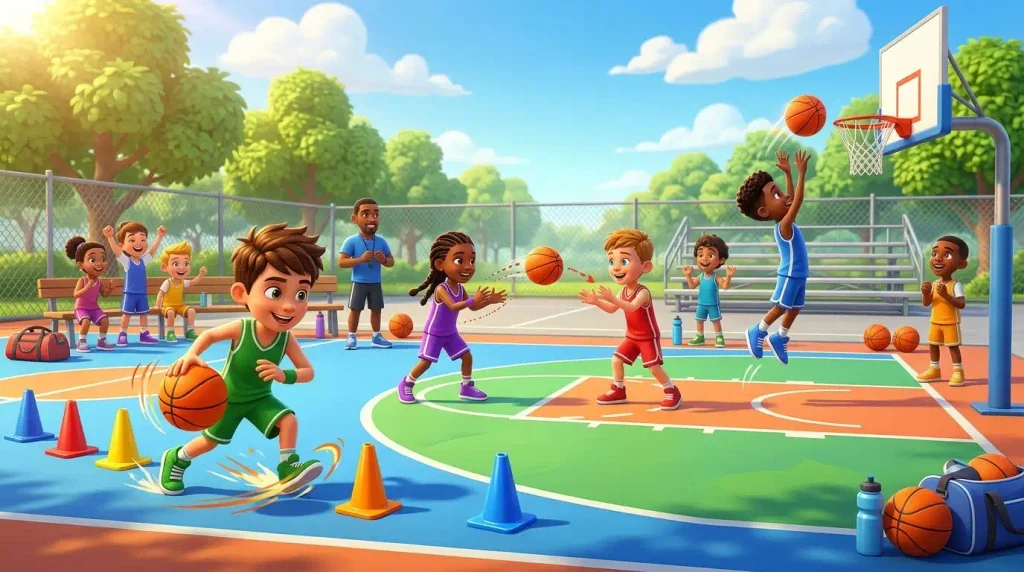
Fun basketball drills are interactive, game-based practices designed to teach core skills like dribbling, passing, shooting, and defense while keeping players engaged. By blending friendly competition, team tag, relay races, and goal-oriented games, these practices build muscle memory, foster teamwork, and prevent burnout for players of all skill levels.
Have you ever walked onto a court and noticed young players dragging their feet during repetitive baseline running? Transforming routine practice into a series of fun basketball drills brings instant energy back to the gym floor.
When coaches use creative fun basketball drills, players learn essential court skills without feeling stressed or bored. Mixing friendly games with skill-building exercises keeps everyone excited to work hard every single session.
Whether you coach a youth squad or just want to refresh your own solo workouts, incorporating fun basketball drills builds real confidence. Let us explore the best games, setups, and coaching tips to make every practice unforgettable!
Why Gamified Practices Build Better Basketball Players
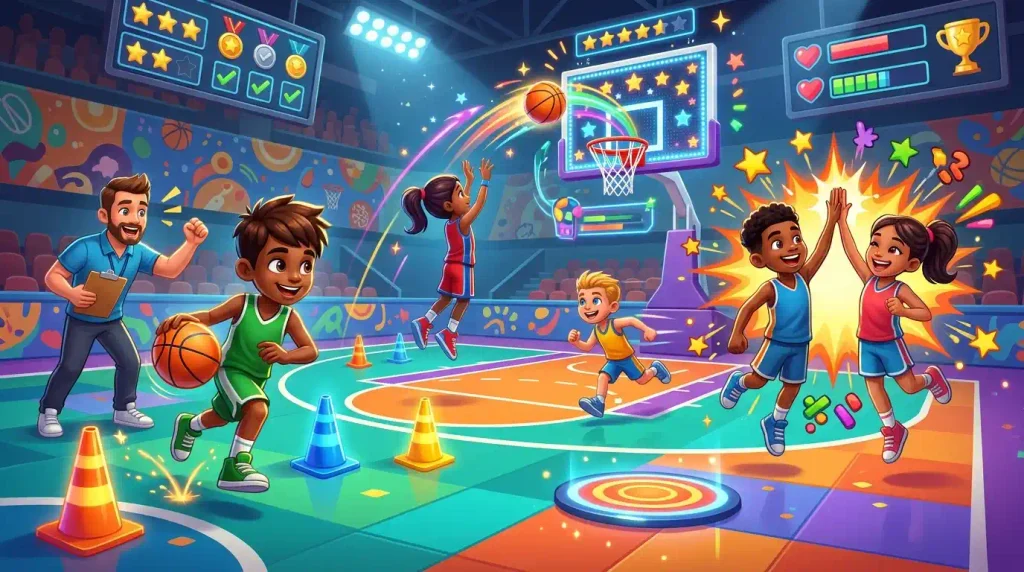
Understanding why game-based training works is the secret to developing skilled, confident athletes. When kids view workouts as play rather than chores, their learning speed skyrockets.
Sports psychologists consistently find that positive emotional connections to training lead to longer participation rates in youth sports.
How Joy Drives Motor Skill Retention
When a player enjoys an exercise, their brain releases dopamine, which reinforces neural pathways responsible for movement memory. That means a child playing a tag game while dribbling develops court vision faster than one staring at the floor doing simple cone lines.
- Gamified challenges encourage natural, instinctive decision-making instead of stiff, overthought movements.
- Players push through physical fatigue longer when focused on winning a team game.
- Mistakes feel like natural parts of play rather than embarrassing failures.
Using games allows players to build core physical habits while having a great time.
Preventing Youth Athlete Burnout
Strict drills and constant pressure cause many talented young athletes to quit sports before reaching high school. Blending structured skill work with playful competition keeps the sport fresh and exciting.
Players look forward to practice when they know they will laugh with their teammates while competing for fun titles.
Fostering Genuine Team Communication
Traditional line drills often keep players quiet as they wait for their turn. Competitive team games force players to talk, call out screens, and cheer for each other naturally.
That loud court communication translates directly into better teamwork during real, high-pressure tournament games.
High-Energy Dribbling Games for Ball Control
Dribbling is the foundation of basketball confidence. If a player cannot control the ball without staring down at their feet, they cannot see open teammates or driving lanes.
These high-energy games force players to keep their eyes up while mastering crossovers, speed changes, and protective dribbling.
Dribble Knockout (The Classic Ring Battle)
Dribble Knockout is a staple for every coach because it teaches ball protection under intense pressure.
- Gather all players inside the key or three-point arc, giving each player a basketball.
- Every player must maintain a continuous dribble while trying to swipe away other players’ balls.
- If a player loses control of their ball or steps out of bounds, they leave the ring.
- Shrink the boundary area as players are eliminated to keep the action intense until one champion remains.
This drill teaches players how to use their body as a shield while keeping their eyes moving.
Red Light, Green Light: Court Vision Edition
This familiar childhood game translates perfectly onto the hardwood to teach speed control and sudden stopping.
- One player or coach stands at the far baseline as the controller, while all other players line up at the opposite baseline with balls.
- When the controller calls “Green Light,” players dribble as fast as possible down the court.
- When “Red Light” is called, players must instantly stop in a balanced triple-threat stance without losing control of their dribble.
- If anyone moves or loses their dribble after “Red Light,” they return to the starting line.
To add difficulty, have the controller hold up colored cards instead of speaking, forcing players to keep their eyes up to read the signals.
Pac-Man Dribble Chase
Pac-Man forces players to practice sharp directional changes and precise footwork along court lines.
Select two players to be “ghosts” who try to tag other players. All players must continuously dribble while running strictly along the painted court lines.
If a player steps off a line or stops dribbling, they become a ghost. This drill makes footwork practice feel like an arcade adventure.
Engaging Shooting Challenges for All Skill Levels
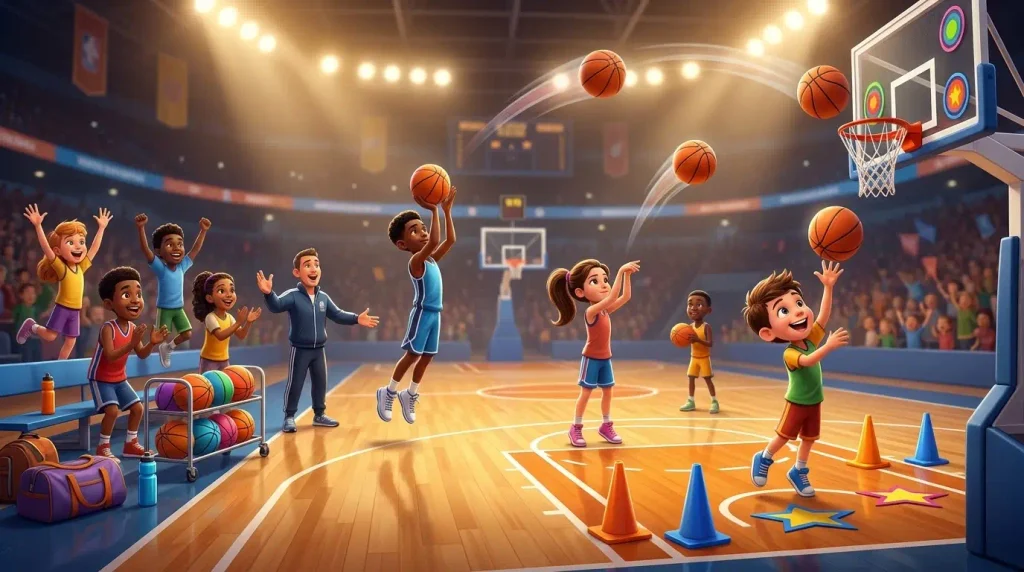
Shooting drills can quickly become tedious if players simply stand in line waiting to shoot from one spot. Adding time pressure, team scoring, and moving targets creates realistic game situations that build clutch shooters.
Here are shooting games that teach proper technique under pressure.
Knockout (Lightning)
Knockout is arguably the most famous basketball shooting game in the world, perfect for ending practice on a high note.
- Form a single line at the free-throw line, with the first two players holding basketballs.
- The first player shoots. As soon as the ball leaves their hands, the second player can shoot.
- If the first player misses, they can tip the ball in from anywhere on the court.
- If the second player makes a basket before the first player, the first player is knocked out.
- The ball is quickly passed to the next person in line, and the frantic cycle continues.
Teaches players to hurry their follow-through without panicking on missed shots.
Around the World
Around the World builds shooting consistency from various spots around the key.
- Set up five distinct shooting spots: right corner, right wing, top of the key, left wing, and left corner.
- A player must make a shot from spot one before advancing to spot two.
- If a player misses, they can choose to “chance it.” If they make the chance shot, they advance. If they miss, they reset to spot one.
- The first player to complete the circuit around and back wins the round.
This game teaches risk assessment, focus, and shooting mechanics from different angles.
Musical Chairs Shooting Sprint
Combine fitness, agility, and shooting accuracy with this fast-paced team challenge.
Place four basketballs on the floor along the three-point line for a group of five players. On the whistle, players sprint around the perimeter. When the coach shouts “Shoot!”, players must grab a ball and hit a layup or jump shot.
The player left without a ball or the last person to make a basket gets eliminated for that round.
Defensive and Conditioning Drills That Players Love
Defense and conditioning are usually the least popular parts of practice. However, framing defensive movement as a competitive game removes the dread and builds tough, proud defenders.
These drills build lateral quickness, core stability, and reaction speed through play.
Steal the Bacon: Defensive Reaction Test
This drill sharpens reaction time and defensive positioning in a fun, split-second duel.
- Divide the team into two equal lines sitting along opposite sidelines, assigning each player a number.
- Place a basketball directly in the center of the court.
- Call out a number. The two players with that number sprint to the center ball.
- The player who grabs the ball becomes the offensive player, while the other instantly drops into a defensive stance.
- The attacker tries to score on a designated basket while the defender works to wall them off.
This competitive setup conditions players to transition instantly between offense and defense.
Chain Tag Defensive Slide
Chain Tag turns boring sliding drills into a chaotic, cooperative chase.
Start with one defender in the center of the court. The defender must stay in a low, wide defensive stance while sliding to tag free runners.
When a runner gets tagged, they link arms with the defender, forming a chain. As the chain grows, players must communicate constantly to slide in unison and trap the remaining runners.
Mirror Shuffle Duel
Pair up players facing each other along the key lane lines. One player acts as the leader, sliding side-to-side, fake-stepping, and dropping low.
The second player must mirror every single movement without crossing their feet or rising out of their stance. Switch roles every thirty seconds to keep heart rates high and legs burning in a competitive environment.
Comprehensive Basketball Drill Matrix
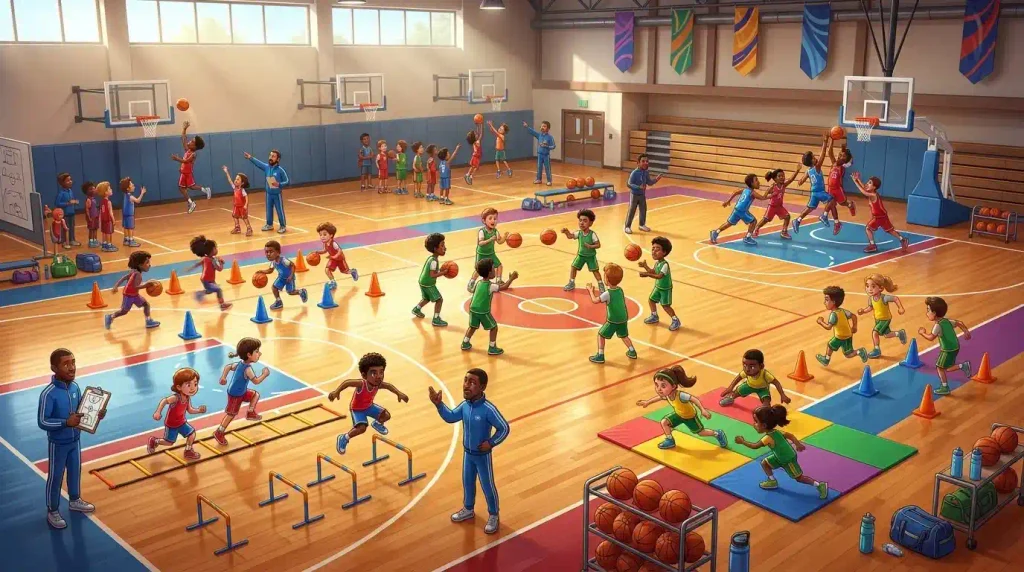
Matching Drills to Team Needs
Using the drill matrix helps coaches balance their weekly practice plans effectively. Beginner squads benefit most from low-stress vision games like Red Light, Green Light, which build fundamental control without intimidation.
Intermediate and advanced teams need high-intensity challenges like Steal the Bacon to mimic real game pressure and speed.
Structuring Practice Energy Flow
Never schedule high-intensity knockout games back-to-back, as players will tire quickly and lose their form. Alternate between high-cardio exercises like Chain Tag and precision tasks like Around the World.
This balanced pacing keeps energy high throughout the entire two-hour session without causing physical exhaustion.
Adapting Drills for Group Sizes
If you have a large squad of fifteen or more players, split the court into two zones so players do not spend time standing in long lines. High engagement keeps players focused and prevents behavior distractions on the sidelines.
How Coaches Can Design Custom Skill Games
You do not have to rely only on classic drills. Understanding basic game design lets you turn any standard technique into an exciting custom challenge for your squad.
Here is a step-by-step framework to turn boring practice reps into memorable games.
Step 1: Identify the Core Skill to Train
Start by selecting one specific skill your team struggled with during their last game.
- Poor weak-hand dribbling under pressure.
- Slow transitions from defense to offense.
- Missed box-outs on defensive rebounds.
Pinpointing the exact physical issue keeps your new game focused on real development goals.
Step 2: Add Clear Scoring Rules and Time Limits
Add a point system and a ticking clock to increase focus and intensity instantly.
Instead of asking players to make ten layups, set a two-minute timer and challenge them to beat their team record of twenty-four made shots. Add consequences, like the losing team doing five jumping jacks, for fun stakes.
Step 3: Introduce Quirky Constraints
Constraints force players to problem-solve creatively during movement.
- Require players to use only their weak hand during dribble games.
- Rule that every possession must include at least three passes before a shot can be taken.
- Award double points for shots made off a crisp bounce pass assist.
These unique rules push players out of their comfort zones while keeping the mood light.
Practice Exercise
Test your coaching knowledge, basketball drill rules, and skill development strategies with these 10 multiple-choice questions!
Questions 1–5
1. Which neurotransmitter plays an important role in motivation and reward during enjoyable learning activities?
A. Melatonin
B. Cortisol
C. Dopamine
D. Adrenaline
2. What important ability do players develop through Dribble Knockout?
A. Protecting possession while maintaining court awareness
B. Improving vertical jumping
C. Practicing referee signals
D. Increasing free-throw accuracy
3. What skill does Red Light, Green Light develop in young basketball players?
A. Better shooting accuracy
B. Improved passing techniques
C. Stronger jumping ability
D. Quick visual recognition and dribbling control
4. What must players accomplish to win the basketball game Knockout?
A. Complete ten successful passes
B. Make a basket before the player behind them
C. Score from the opposite end of the court
D. Dribble through a series of obstacles
5. Which ability does Chain Tag primarily develop during basketball practice?
A. Individual shooting accuracy
B. Long-distance passing
C. Coordinated defensive movement and communication
D. Stationary ball handling
Questions 6–10
6. Which shooting game encourages players to attempt baskets from different positions around the key?
A. Around the World
B. Pac-Man Dribble
C. Mirror Shuffle
D. Steal the Bacon
7. How can coaches maintain an effective balance between different practice intensities?
A. Remove all recovery periods
B. Focus exclusively on competitive games
C. Avoid technical exercises
D. Alternate energetic activities with focused skill practice
8. Which basketball drill involves two numbered teams competing to retrieve a ball from the center?
A. Musical Chairs
B. Steal the Bacon
C. Chain Tag
D. Dribble Knockout
9. How do weak-hand-only drills improve basketball performance?
A. Better court decoration
B. Faster running speed
C. Stronger jumping ability
D. Improved ball control and coordination with both hands
10. Which training environment can increase the risk of burnout among young athletes?
A. Repetitive, high-pressure practices without enjoyment
B. Friendly team-building competitions
C. Recreational outdoor activities
D. Supportive coaching and positive feedback
Answer Key
1-C | 2-A | 3-D | 4-B | 5-C | 6-A | 7-D | 8-B | 9-C | 10-A
FAQs
How do fun basketball drills help improve real game performance?
Fun drills improve performance by simulating real game pressure, unpredictable movement, and rapid decision-making. When players practice skills in dynamic, game-like settings, they react faster and make smarter choices during high-pressure tournament play.
What are the best drills for absolute beginners aged five to eight?
The best drills for young beginners are simple games like Red Light, Green Light, Pac-Man Dribble, and modified relay races. These games focus on basic motor coordination, spatial awareness, and keeping eyes up without overwhelming kids with complex rules.
How much practice time should be dedicated to fun games?
Coaches should dedicate roughly twenty to thirty percent of practice time to gamified drills, especially at youth levels. Ending every session with a ten-minute competitive game leaves players feeling accomplished and eager for the next practice.
Can experienced high school teams benefit from gamified drills?
Yes, high school teams benefit greatly from competitive skill games that build team chemistry and relieve stress. Advanced players thrive on timed shooting challenges, fast-break scoring duels, and high-stakes defensive reaction games.
How do you handle players who get overly upset when losing practice games?
Use losing moments to teach sportsmanship, resilience, and emotional control. Emphasize effort over winning, reset games quickly, and mix up team rosters frequently so every player experiences both winning and working through losses.
What equipment is needed to run creative basketball games?
Most creative games require basic court equipment like basketballs, painted floor lines, and colorful agility cones. You can also add lightweight pinnies for team identification, tennis balls for hand-eye tracking, or timers to add fun pressure.
How can solo players make individual workouts more enjoyable at home?
Solo players can gamify workouts by setting beat-the-clock challenges, tracking personal shooting percentages, or pretending to play against real rival players. Setting concrete targets turns solitary driveway practice into an exciting personal challenge.
Conclusion
Integrating creative fun basketball drills into your routine changes how athletes learn, perform, and connect on the court. Moving away from boring, repetitive routines creates an inviting environment where players push their limits and build real skills naturally.
From energetic ball-handling games like Dribble Knockout to clutch shooting challenges like Around the World, gamified training develops complete, confident basketball players. When athletes love their practice environment, their effort, court communication, and overall game performance thrive.
Try adding two or three of these exciting, fun basketball drills to your very next practice session. Watch your team’s energy soar, support your players as they grow, and enjoy seeing their shared passion for the game shine on the court!

Ghzala Rani is the creator and writer behind Funzonest.com, a website dedicated to making everyday topics more enjoyable, interesting, and easy to understand. With a passion for engaging content, Ghzala focuses on creating helpful articles that inform, entertain, and provide readers with useful ideas and insights.
Through Funzonest.com, Ghzala Rani aims to build a friendly online space where readers can discover fresh content and explore topics presented in a simple and enjoyable way. Her writing style focuses on clarity, originality, and reader value. She is committed to publishing well-researched and engaging content that keeps visitors informed while making their time on the website enjoyable.