

Flamingo fun lies in discovering how these striking pink birds navigate their wild environments, balance effortlessly on one leg, and filter food from alkaline lakes. Learning these incredible facts helps readers understand avian biology, colorful diets, and social behaviors in an entertaining, easy-to-understand way.
Have you ever wondered why bright pink birds stand gracefully on one leg while eating upside down? Exploring flamingo fun reveals the surprising biological tricks and quirky social habits that make these birds truly unique.
Nature lovers and curious minds everywhere are constantly fascinated by these tall, leggy creatures in muddy lagoons. Uncovering flamingo fun gives you a whole new appreciation for wildlife and coastal ecosystems.
Let us take a closer look at these incredible birds together and discover what makes flamingo fun so endlessly captivating.
The Secret World of Pink Wading Birds

Flamingos are among the most recognizable birds on the planet, yet most people know very little about how they actually live. They inhabit harsh, salty lakes where few other animals can survive, turning tough environments into thriving communities.
These birds have lived in tropical and subtropical regions for millions of years, developing specialized body parts along the way. Understanding their daily habits gives us a front-row seat to one of nature’s most colorful success stories.
How Flamingos Get Their Iconic Pink Color
When baby flamingos hatch from their eggs, they are not pink at all; they are covered in fluffy grey or white down feathers. Their famous vibrant shade develops gradually over the first couple of years of their lives through their daily diet.
The Role of Carotenoid Pigments in Diets
Flamingos feed heavily on brine shrimp, microscopic algae, and small crustaceans packed with natural chemical compounds called carotenoids. These are the same natural pigments that make carrots orange and ripe tomatoes bright red.
As the bird digests its food, enzymes break down these pigments and deposit them directly into growing feathers, skin, and beak tissue. Without this pigment-rich diet, a flamingo’s feathers eventually fade to a dull white or light grey color.
How Zoo Diets Maintain Feathers
In wildlife parks and zoos, animal care teams must carefully replicate this natural diet to keep the birds healthy and bright. They feed the birds specialized food pellets fortified with natural carotenoid nutrients like beta-carotene.
If a zoo bird does not receive these nutrient supplements, its bright pink plumage slowly turns pale over successive molting seasons. Maintaining proper nutrition ensures these birds remain healthy and vibrant for visitors to admire.
The Mystery of the One-Legged Balance
Watching a flamingo nap peacefully while balancing on a single skinny leg is a classic sight that confuses many observers. Scientists spent decades testing different theories before finally figuring out why these birds prefer this asymmetrical stance.
Passive Gravity Mechanisms in Bird Legs
Researchers discovered that flamingos use a passive mechanical locking mechanism in their joints rather than active muscle force. When the bird stands on one leg, its body weight automatically locks the knee joint into a rigid position.
This structural setup allows the bird to remain perfectly still without using active muscular effort or burning extra calories. In fact, a flamingo uses less physical energy standing on one leg than it does standing on two.
Temperature Regulation and Heat Conservation
Another key reason for one-legged standing involves preserving body warmth while standing in cold water for hours. Birds lose a significant amount of body heat through their unfeathered legs and webbing.
Tucking one leg snugly against warm belly feathers cuts thermal heat loss directly in half while feeding in chilly lagoons. This clever behavior keeps their core body temperature stable throughout long feeding sessions.
Amazing Physical Adaptations and Feeding Tricks
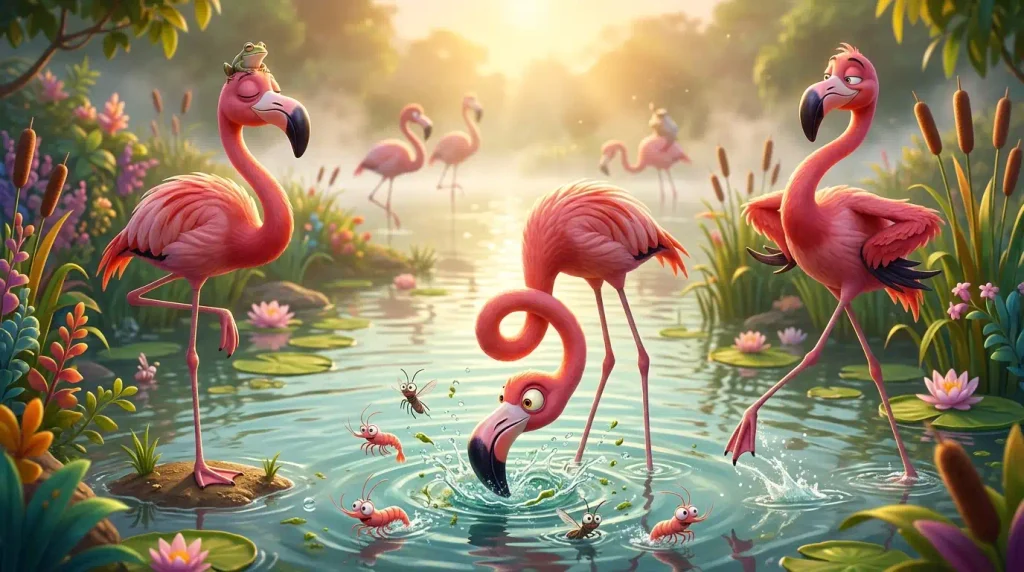
Living in extreme environments requires specialized equipment that sets flamingos apart from ordinary wading birds. Every part of their body, from their curved beaks to their webbed toes, is built for survival in tough conditions.
The Science of Upside-Down Feeding
Flamingos possess one of the most unusual beak structures in the entire animal kingdom, specifically designed for filter feeding. Unlike humans, a flamingo’s lower beak is large and rigid, while the upper beak is smaller and highly mobile.
Filtering Microscopic Food Particles
To feed, the bird lowers its head into the water until its beak hangs completely upside down, facing backward. It moves its thick, fleshy tongue back and forth like a mechanical piston to pump muddy water through its bill.
Special hairy structures inside the beak, called lamellae, act like tiny sieves that trap microscopic food while pushing mud out. This efficient filtering system allows them to scoop up thousands of organisms in a single minute.
Tolerating Extreme Water Conditions
Flamingos frequently feed in highly alkaline lakes containing dense concentrations of caustic salts and mineral compounds. These waters would severely burn human skin, yet flamingos wade through them comfortably without suffering harm.
Their legs are covered in tough, leathery skin that shields internal tissues from chemical burns and sharp salt crusts. Additionally, specialized glands near their eyes filter excess salt out of their bloodstream, allowing them to drink brackish water safely.
Unique Flight Mechanics and Migration Patterns
Despite their heavy bodies and gangly legs, flamingos are powerful long-distance flyers capable of traveling hundreds of miles overnight. Watching a large flock take off over water is a dramatic visual display.
Running Starts and Airborne Formation
Because of their large body mass, flamingos cannot simply leap straight into the air as small songbirds do. They must take a running start across the mud or shallow water, flapping their broad wings rapidly to build up speed.
Once airborne, they stretch their long necks straight out in front and extend their legs straight behind to streamline their flight path. Flocks travel in tight V-formations or long diagonal lines to reduce wind resistance and conserve group energy.
Overnight Migration Journeys
Flamingos prefer traveling at night when the air is cooler and predatory birds are less active in the skies. A flock can cover over three hundred miles in a single night traveling at speeds near thirty-five miles per hour.
They use thermal air currents and coastal landmarks to navigate between breeding grounds and seasonal feeding lakes. When daylight breaks, they touch down smoothly in fresh mudflats ready to feed again.
Comparing Flamingo Species Around the World

Comparing the six living flamingo species helps us understand how subtle differences in geographic location and diet shape these iconic birds. While all flamingos share tall legs and filter-feeding beaks, each species features unique feather shades, leg colors, and physical adaptations tailored to its specific habitat.
Size Differences and Body Features
Flamingo species vary significantly in size, ranging from the towering Greater Flamingo to the compact Lesser Flamingo. Greater Flamingos stand up to five feet tall with pale pink feathers, while Lesser Flamingos reach only three feet in height with deeper crimson plumage. Body weight, bill curvature, and wing length also differ to help each species thrive in its local environment.
Distinct Leg Colors and Facial Markings
One of the easiest ways to identify different flamingo species in the wild is by observing their legs and beak patterns. Chilean Flamingos feature grey legs with bright pink knee joints, whereas Andean Flamingos stand out with unique yellow legs and a black-tipped bill. Puna Flamingos display deep red spots near their nostrils, making each species visually distinct to birdwatchers.
Geographic Distribution and Habitat Preferences
Flamingo species occupy diverse regions across Africa, Asia, Europe, and the Americas, adapting to salty lagoons, alkaline lakes, and high-altitude mountain waters. For instance, Caribbean Flamingos prefer warm coastal mudflats and mangrove swamps, while Andean Flamingos inhabit harsh saltwater lakes high up in the Andes Mountains. Understanding these habitats helps conservationists protect delicate ecosystems worldwide.
Social Habits and Massive Colony Dynamics
Flamingos are incredibly social birds that rarely live alone; they rely on large group numbers for safety, mating, and warmth. A single gathering, formally known as a flamboyance, can number in the hundreds of thousands of individual birds.
Group Courtship Dances and Displays
Before breeding season begins, entire colonies organize massive synchronized dances to select mating partners. These group rituals ensure that the maximum number of birds become ready to lay eggs at the exact same time.
- Head flagging involves lifting necks high and sweeping heads smoothly back and forth in rhythm.
- Wing saluting occurs when birds spread their dark flight feathers to display bold color contrasts.
- Marching displays feature thousands of birds walking together in tight formation like a marching band.
- Preening calls sound when birds quickly touch their bills to feathers while turning their bodies.
Building Mud Nests and Raising Chicks
Flamingo pairs work together as equal partners to build mud nests, incubate single eggs, and raise fluffy grey chicks. Their teamwork ensures high survival rates even in harsh nesting environments.
Constructing Volcano-Shaped Nests
Parents use their curved beaks to scrape wet mud into raised mound structures shaped like mini volcanoes. These mud mounds can stand up to twelve inches high above the surrounding marsh floor.
Raising the nest above the water level protects the single egg from unexpected flooding and extreme ground heat. Both mother and father take turns sitting on the nest for roughly thirty days until the chick hatches.
Feeding Chicks Crop Milk
Unlike most birds that feed their chicks solid insects or fish, flamingos produce a special liquid called crop milk. This rich substance is secreted from the lining of the parent’s upper digestive tract and fed directly into the chick’s beak.
Both male and female parents produce crop milk packed with healthy fats, proteins, and essential red blood cells. This unique nourishment allows chicks to grow rapidly during their first few weeks of life before their beaks develop filter plates.
Fun Culture and Pop Icon Status

Beyond their biological wonders, flamingos hold a special place in modern pop culture, home design, and fashion globally. Their quirky shape and bold color make them universal symbols of tropical relaxation, fun, and warm summer weather.
The Invention of the Plastic Lawn Flamingo
In 1957, an artist named Don Featherstone designed the famous pink plastic lawn flamingo for a company in Massachusetts. The affordable pair of yard ornaments quickly became an iconic American pop culture symbol throughout suburbs nationwide.
What started as simple mid-century lawn decor evolved into a global symbol of retro style, kitsch art, and whimsical humor. Today, plastic flamingos remain popular decorations for backyard parties, tropical events, and neighborhood pranks.
Symbolic Meaning in Tropical Travel and Fashion
When people see bright flamingo graphics on clothing, luggage, or beach towels, they instantly think of tropical vacations and sunny beaches. Tourism boards and resorts frequently use flamingo imagery to promote relaxing island getaways.
Their elegant shapes inspire designers in high fashion, home interior decorating, and digital media illustration. Incorporating flamingo motifs adds a splash of bright color, playfulness, and alternative charm to everyday consumer products.
How to Support Flamingo Conservation Efforts

Protecting wild flamingo populations requires worldwide habitat preservation and conscious human choices. Because these wading birds rely on specific wetland ecosystems to feed and nest, supporting global conservation efforts ensures their vibrant colonies remain safe from habitat destruction and pollution.
Protecting Coastal Lagoons and Saltwater Wetlands
The greatest threat to wild flamingos is the loss of their natural feeding and nesting grounds due to industrial expansion and water diversion. Coastal mudflats, alkaline lakes, and saltwater lagoons provide the quiet, nutrient-rich conditions these birds need to breed successfully. Supporting organizations that fight to create marine protected areas and preserve natural wetlands helps safeguard vital habitats for future generations.
Reducing Plastic Consumption and Chemical Runoff
Plastic waste, marine garbage, and chemical pollution from agriculture heavily contaminate the shallow lakes where flamingos feed. Microplastics and industrial runoff poison the brine shrimp and algae that make up the bird’s natural diet. By reducing single-use plastic consumption, properly disposing of trash, and choosing eco-friendly products, you directly help keep ocean waterways and wetland ecosystems clean.
Supporting Eco-Tourism and Wildlife Conservation Funds
Choosing responsible, non-intrusive wildlife travel allows local communities to benefit financially from protecting flamingos rather than developing their habitats. When visiting wetland reserves, keeping a respectful distance prevents disturbing nesting colonies during delicate breeding seasons. Additionally, donating to or volunteering with reputable wildlife conservation funds helps research teams monitor bird populations and enforce environmental protection laws globally.
Practice Exercise
Test your knowledge about flamingos with these multiple-choice questions based on the details covered in this guide.
Flamingo Features and Feeding
- What causes wild flamingos to develop their distinct pink and red feather colors?
A. Natural pigments absorbed from sunlight
B. Carotenoid pigments in their natural diet
C. Minerals absorbed through their feet from mud
D. Oil glands located near the base of their tails - Why do flamingos use less muscular energy when standing on one leg?
A. Their leg joints lock into place using body weight
B. They use hidden skin pouches to support their weight
C. Their bones are filled with heavy liquid ballast
D. Their tail feathers act as a third stabilizing tripod - How does a flamingo position its head when filtering food from muddy water?
A. Tilted sideways at a forty-five-degree angle
B. Completely upside down facing backward
C. Floating flat on top of the water surface
D. Submerged straight down like an arrow - What specialized structures inside a flamingo’s beak filter out tiny food particles?
A. Lamellae
B. Ampullae
C. Carotenoids
D. Whiskers - What is a group of flamingos formally called by bird enthusiasts?
A. A flock
B. A flamboyance
C. A parade
D. A cluster
Flamingo Species and Interesting Facts
- Which flamingo species is the largest in physical size?
A. Lesser Flamingo
B. Chilean Flamingo
C. Greater Flamingo
D. Puna Flamingo - What shape do flamingo parents build their mud nests into before laying an egg?
A. Deep underground tunnels
B. Flat circular grass mats
C. Raised volcano-shaped mounds
D. Floating reed rafts - What substance do parents feed their newborn chicks during early life stages?
A. Grounded sea salt
B. Crop milk
C. Whole brine shrimp
D. Liquid mud paste - Who designed the iconic pink plastic lawn flamingo in 1957?
A. Don Featherstone
B. James Audubon
C. Charles Darwin
D. Ansel Adams - Why do flamingos tuck one leg against their belly while standing in cold water?
A. To rest their swimming webs
B. To conserve body heat and reduce thermal loss
C. To attract tiny fish toward their feet
D. To stretch their hip joints before flight
Answer Key
B | A | B | A | B | C | C | B | A | B
FAQs
Why are flamingos born grey instead of pink?
Flamingo chicks hatch grey or white because they have not ingested foods containing natural carotenoid pigments yet. As they eat algae and brine shrimp over two years, the pigments build up and turn their feathers pink.
Can flamingos fly long distances in the wild?
Yes, flamingos are excellent long-distance flyers that migrate hundreds of miles between seasonal lakes at night. They stretch their necks forward and legs backward in flight, reaching speeds around thirty-five miles per hour.
How long do wild flamingos usually live?
Wild flamingos typically live twenty to thirty years in nature, protected by large group numbers in remote lakes. In protected zoo settings, individual flamingos can live fifty years or longer with constant care and proper food.
Do flamingos have teeth inside their curved beaks?
No, flamingos do not have true teeth inside their beaks like mammals do. Instead, they feature comb-like structures called lamellae along the edges of their bills to filter tiny food from muddy water.
Why do flamingos build raised mud nests?
Flamingos build raised volcano-shaped mud mounds to keep single eggs safe from sudden water level rises and extreme ground heat. The height keeps eggs clean, warm, and dry during the thirty-day incubation period.
Are all flamingo species identical in color?
No, feather colors vary across species based on location and diet density. Caribbean flamingos show deep red-orange feathers, while Greater flamingos display pale pink bodies with bright crimson wing accents.
Conclusion
Exploring these iconic pink wading birds reveals how adaptation and playful traits come together in nature. Understanding how flamingos filter food upside down and balance effortlessly on one leg highlights the wonders of wild ecosystems.
Sharing these fun facts with friends keeps wildlife education exciting, engaging, and memorable for readers of all ages. Supporting wetland conservation and protecting natural habitats ensures these beautiful birds continue to flourish across their native environments.
Take time to discover more about our natural world through this curated collection of flamingo fun resources and start exploring the fascinating world of these remarkable birds today!

Ghzala Rani is the creator and writer behind Funzonest.com, a website dedicated to making everyday topics more enjoyable, interesting, and easy to understand. With a passion for engaging content, Ghzala focuses on creating helpful articles that inform, entertain, and provide readers with useful ideas and insights.
Through Funzonest.com, Ghzala Rani aims to build a friendly online space where readers can discover fresh content and explore topics presented in a simple and enjoyable way. Her writing style focuses on clarity, originality, and reader value. She is committed to publishing well-researched and engaging content that keeps visitors informed while making their time on the website enjoyable.