

Euclid of Alexandria was an ancient Greek mathematician known as the “Father of Geometry.” He revolutionized mathematics by organizing geometric knowledge into a logical system in his famous book, Elements, which served as the world’s primary math textbook for over two thousand years.
Have you ever wondered who turned simple lines and shapes into an exact science? Exploring incredible Euclid fun facts reveals how an ancient Greek thinker shaped everything from computer graphics to modern architectural design.
You might remember geometry as a school subject full of proofs and formulas, but the story behind its founder is full of drama and wonder. Learning these Euclid fun facts helps you see how one brilliant mind laid the foundation for modern science.
Euclid created a logical system that taught humanity how to think clearly and prove truth beyond any doubt. His ideas traveled across centuries, inspiring giants like Isaac Newton, Albert Einstein, and Abraham Lincoln.
Let us explore his fascinating world together through these captivating Euclid fun facts. You will discover why his work remains so powerful and relevant in our high-tech world today!
Who Was Euclid? The Mysterious Father of Geometry

To truly understand how geometry shaped human civilization, we must first look at the enigmatic figure who organized it. Euclid of Alexandria was an ancient Greek mathematician who flourished around 300 BCE in Egypt, during a golden age of scientific discovery. Despite his monumental influence on modern mathematics and philosophy, very few personal biographical details about his life survived the destruction of ancient records. We know he led a famous mathematical school at the Library of Alexandria, but his exact birthdate, birthplace, and family background remain complete mysteries to modern historians.
Unlike other ancient scholars who wrote memoirs or personal diaries, Euclid dedicated his life entirely to documenting mathematical principles. This remarkable lack of personal information even led a few nineteenth-century scholars to speculate whether “Euclid” was a single genius or a pseudonym used by a team of mathematicians. However, most modern historians agree he was a real scholar whose personal modesty allowed his revolutionary mathematical proofs to outshine his personal biography.
The Mystery Surrounding His Personal Life
The complete absence of personal anecdotes from Euclid’s writings stands in stark contrast to other famous ancient thinkers like Archimedes or Pythagoras. While stories of Archimedes leaping from his bathtub shouting “Eureka!” survived through the centuries, Euclid left behind zero personal anecdotes in his published manuscripts. He cared deeply about objective mathematical truth, ensuring that his logical deductions stood on their own merit without relying on the authority of his personal reputation.
This selfless focus on pure logic created a timeless standard for scientific writing that we still respect in academic research today. Scholars throughout history have admired how Euclid erased his own ego from his work, creating a clean, universal system of geometry that belongs equally to all of humanity regardless of culture or era.
Alexandria: The Intellectual Capital of the Ancient World
Euclid carried out his life’s work in Alexandria, Egypt, during a period when the city was the absolute center of global education and scientific progress. Founded by Alexander the Great and ruled by King Ptolemy I, Alexandria boasted the famous Great Library and Museum, which attracted scholars, astronomers, and philosophers from across the Mediterranean basin.
In this vibrant intellectual hub, Euclid had unprecedented access to centuries of mathematical scrolls collected from ancient Babylonia, Egypt, and Greece. He spent decades gathering these scattered, unorganized geometric ideas, testing their validity, and organizing them into a single, logical textbook series that would educate the entire world for millennia.
Mind-Blowing Euclid Fun Facts About His Legendary Book “Elements”
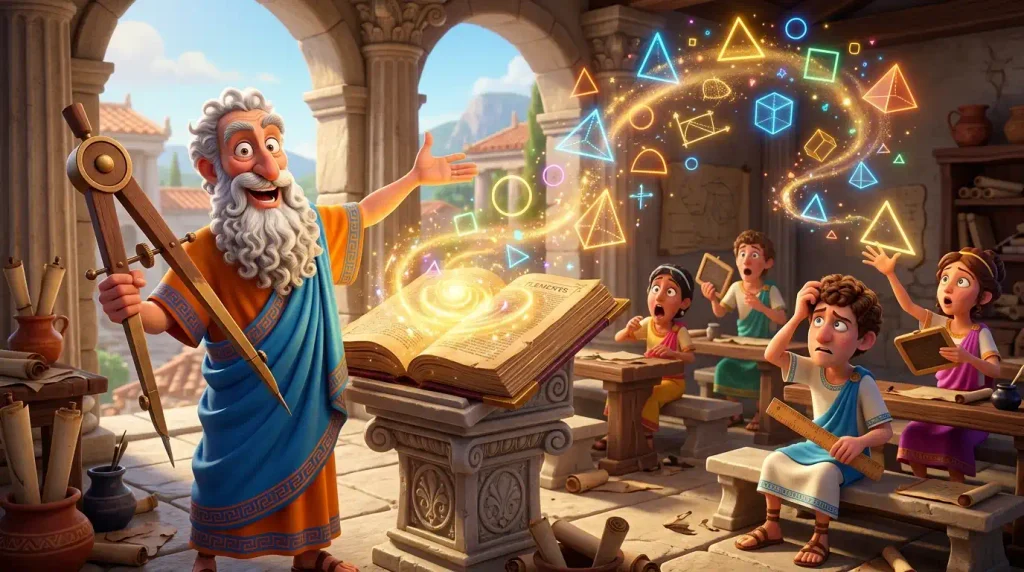
Euclid’s defining achievement was writing a masterwork titled Elements, a thirteen-book compilation that transformed mathematics from a collection of isolated tricks into a rigorous logical discipline.
1. It Is the Second Most Printed Book in Human History
Following the invention of the movable type printing press by Johannes Gutenberg in 1440, Elements was mass-produced across Europe and translated into dozens of languages. Historians estimate that in terms of total editions published, translated, and studied worldwide, Elements is second only to the Bible.
2. It Served as the Standard Math Textbook for 2,000 Years
Imagine a single academic textbook staying in continuous classroom use for over two thousand years without ever going out of date. Schoolchildren, university scholars, and scientific researchers across Europe, the Middle East, and Asia studied plane geometry directly from Euclid’s Elements from 300 BCE all the way into the early twentieth century.
3. Abraham Lincoln Carried Euclid in His Saddlebags
Long before he served as the sixteenth President of the United States, Abraham Lincoln carried a copy of Euclid’s Elements in his saddlebags as a traveling lawyer. Lincoln spent long nights studying Euclid’s proofs by candlelight to train his mind in rigorous logical deduction, later using Euclidean proof structures to compose clear, convincing legal arguments in court and powerful political speeches.
4. Albert Einstein Called It His “Holy Geometry Book”
When Albert Einstein was just twelve years old, a family friend gifted him a small textbook on Euclidean geometry. Einstein was so captivated by the absolute certainty of Euclid’s step-by-step proofs that he referred to it throughout his life as his “sacred little geometry book,” crediting Euclid with sparking his lifelong passion for theoretical physics.
The Logical Superpowers of Euclid’s Geometry

Euclid did not simply list geometric formulas; he invented an entirely new methodology for building human knowledge called the axiomatic method, which starts with basic truths to construct complex proofs.
5. He Built an Empire of Knowledge on Just Five Simple Rules
Euclid began his entire system of plane geometry using only five basic, self-evident assumptions known as postulates or axioms. From these five elementary statements—such as the rule that a straight line segment can be drawn between any two points—he logically proved hundreds of intricate geometric theorems without making a single logical error or unproven assumption.
6. The Famous Fifth Postulate Caused 2,000 Years of Arguments
Euclid’s fifth rule, known as the Parallel Postulate, was noticeably longer and more complicated than his first four rules. For two thousand years, mathematicians believed the fifth postulate was actually a theorem that could be proven using the first four rules, but their endless failed attempts eventually led to the accidental discovery of non-Euclidean geometry in the nineteenth century.
7. He Proved That Prime Numbers Go On Forever
In Book IX of Elements, Euclid presented an extraordinarily elegant proof showing that prime numbers never run out. His famous proof by contradiction—assuming a finite list of primes exists and showing that multiplying them together and adding one produces a new prime—is still taught as a masterpiece of mathematical logic in modern universities.
8. He Invented an Algorithm Still Used in Modern Coding
Euclid designed a clever, step-by-step computational method for calculating the greatest common divisor of two integers, known as the Euclidean Algorithm. Computer programmers still use adapted versions of this ancient algorithm in modern digital encryption software to secure online banking transactions and digital communications.
9. He Defined the “Golden Ratio” Mathematically
Euclid was the very first mathematician to provide a precise mathematical definition for what we now call the Golden Ratio. He referred to it as dividing a line in “extreme and mean ratio,” establishing a mathematical proportion that artists, architects, and designers have used for centuries to create visually pleasing compositions in classical buildings and modern art.
How Euclid’s Ideas Shape Our Everyday Modern World
It is easy to assume ancient geometry belongs in a dusty history museum, but Euclid’s core principles actively run our high-tech modern world behind the scenes every single day.
10. Your Smartphone Screen Relies on Euclidean Space
Every mobile phone display, computer monitor, and high-definition television renders images using a two-dimensional grid of pixels mapped across horizontal and vertical axes. This digital canvas operates entirely according to Euclid’s flat plane geometry rules, calculating distance, alignment, and rendering clarity across straight lines.
11. Video Games Use Euclid for 3D Graphics
When you play a modern 3D video game, the graphics processing engine calculates character movements, camera angles, and dynamic lighting using Euclidean geometry formulas. Game developers rely heavily on three-dimensional Euclidean spatial coordinates to render lifelike environments and ensure digital objects interact realistically with virtual gravity and collision boundaries.
12. Architects and Builders Follow His Exact Rules
From ancient Greek temples like the Parthenon to modern steel skyscrapers in major cities, structural engineers rely on Euclid’s geometric rules to ensure buildings remain balanced and stable. His fundamental theorems regarding right triangles, parallel lines, and structural symmetry allow builders to calculate load distribution accurately so structures withstand wind, earthquakes, and time.
13. GPS Navigation Uses Geometric Triangulation
When your smartphone’s GPS navigation app determines your precise physical location on a digital map, it calculates spatial relationships using geometric triangulation from multiple orbiting satellites. This real-time positioning system relies directly on coordinate geometry principles pioneered by Euclid to measure angles and distances across global landscapes accurately.
Surprising and Weird Euclid Fun Facts

Beyond his formal mathematical textbooks, Euclid’s historical story contains plenty of surprising moments, witty interactions, and unusual historical coincidences that bring his personality to life.
14. He Gave a Royal Snub to King Ptolemy I
When King Ptolemy I asked Euclid if there was a quicker, less demanding way to master geometry than reading all thirteen books of Elements, Euclid famously replied, “There is no royal road to geometry.” He made it boldly clear that even powerful monarchs must put in the same dedicated mental effort as ordinary students to understand mathematical truth.
15. He Paid a Student to Learn
A famous historical story tells of a student who completed his first geometry lesson and asked Euclid what practical financial profit he would gain from learning such ideas. Euclid called his servant and said with dry wit, “Give him three coins, since he must make a profit from what he learns,” before promptly dismissing the student from his academy.
16. He Wrote About Music and Light Too
While geometry made him world-famous, Euclid was a polymath who wrote treatises on optics, astronomy, and musical theory. In his work Catoptrics, he studied how light travels in straight lines and reflects off mirrors, while his musical writings applied strict mathematical ratios to musical scales and acoustic harmonies.
17. Most of His Original Writings Were Lost
None of Euclid’s original handwritten papyrus scrolls survived the destruction of ancient Mediterranean libraries over the centuries. The versions of Elements that we read today exist only because dedicated medieval Arabic scholars translated his works during the Islamic Golden Age, preserving them for European scholars to translate back into Latin centuries later.
18. A Crater on the Moon Is Named After Him
To honor his everlasting contributions to human thought, modern astronomers named a prominent lunar impact crater after Euclid. Located near the Oceanus Procellarum on the Moon’s near side, the Euclid Crater measures roughly twelve kilometers in diameter and serves as a permanent celestial tribute to the Father of Geometry.
19. A Space Telescope Bears His Name
The European Space Agency launched the high-tech Euclid Space Telescope into orbit to map the geometry of the dark universe. Scientists named the mission after Euclid because his geometric principles are being used to map the distribution of dark matter and dark energy across billions of light-years of cosmic space.
20. He Pioneered the Use of “Q.E.D.”
At the conclusion of every mathematical proof in Elements, Euclid wrote the Greek phrase oper edei deixai, meaning “which was to be demonstrated.” Medieval Latin translators later converted this closing phrase into Quod Erat Demonstrandum, abbreviated worldwide today as Q.E.D. at the end of formal logical arguments.
Advanced Euclidean Concepts Made Simple
As Euclid expanded his mathematical inquiries beyond simple triangles and circles, he explored advanced concepts that sound complex at first but make perfect sense when broken down step-by-step.
21. Perfect Numbers and Their Secret Formula
Euclid discovered that certain rare integers equal the exact sum of all their proper divisors, excluding the number itself. For example, the number six is divisible by one, two, and three, and adding those factors ($1 + 2 + 3$) equals six. Euclid created an ingenious formula using powers of two and prime numbers to generate these mathematically balanced “perfect numbers.”
22. Inscribing Regular Shapes Inside Circles
Euclid demonstrated how to construct perfect geometric shapes such as equilateral triangles, squares, and regular pentagons inside a circle using only a compass and an unmarked straightedge. His step-by-step techniques for geometric construction were considered the ultimate test of precision drafting skill for centuries of architects and artists.
23. Optics and the Straight Path of Light Rays
In his scientific treatise Optics, Euclid proposed that light travels in perfectly straight paths, allowing him to study shadows, spatial perspectives, and optical illusions mathematically. He used geometric ray diagrams to explain why objects appear smaller as they move farther away and how flat mirrors reflect images accurately to human eyes.
24. The Geometry of 3D Solid Objects
The final books of Elements transition smoothly from flat, two-dimensional geometry to three-dimensional solid shapes. Euclid analyzed the five regular Platonic solids the tetrahedron, cube, octahedron, dodecahedron, and icosahedron—proving mathematically that no other regular three-dimensional shapes can possibly exist in the universe.
25. Regular Tessellations and Tiling Patterns
Euclid investigated how geometric shapes fit together across flat surfaces without leaving empty gaps or creating overlapping edges. His mathematical analysis of regular tiling patterns explains why square ceramic tiles and hexagonal honeycomb structures fit together so seamlessly across flat floors and natural beehives.
Comparing Euclid’s Legacy at a Glance
Euclid’s legacy continues to influence mathematics, education, architecture, and modern technology. His systematic approach to geometry laid the foundation for logical reasoning and mathematical proofs. By organizing geometric principles into definitions, axioms, and theorems, Euclid created a method that students and scholars could follow for centuries. Comparing his contributions with modern mathematical developments shows how his ideas still shape how people understand shapes, measurements, and spatial relationships.
1. Euclid’s Influence on Modern Mathematics
Euclid’s Elements organized essential geometric concepts into a structured system of proofs. This approach influenced later mathematicians and helped establish rigorous standards for mathematical reasoning. Even today, students learn geometric principles that trace their roots to Euclidean geometry.
2. Euclidean Geometry in Everyday Life
Many everyday designs rely on principles associated with Euclidean geometry. Architects use geometric shapes to plan buildings, engineers calculate distances and angles, and designers apply symmetry and proportion to create balanced structures. These practical applications demonstrate how Euclid’s ideas extend beyond textbooks.
3. Euclid’s Legacy Compared With Modern Geometry
Modern mathematics includes several forms of geometry, including non-Euclidean geometry, which explores spaces that do not follow all of Euclid’s original assumptions. Although these newer approaches expanded mathematical understanding, Euclidean geometry remains essential for studying familiar spaces, basic measurements, and many real-world structures. Together, these developments show how Euclid’s work provided a lasting foundation for further discoveries.
Practical Tips for Learning Geometry the Euclidean Way
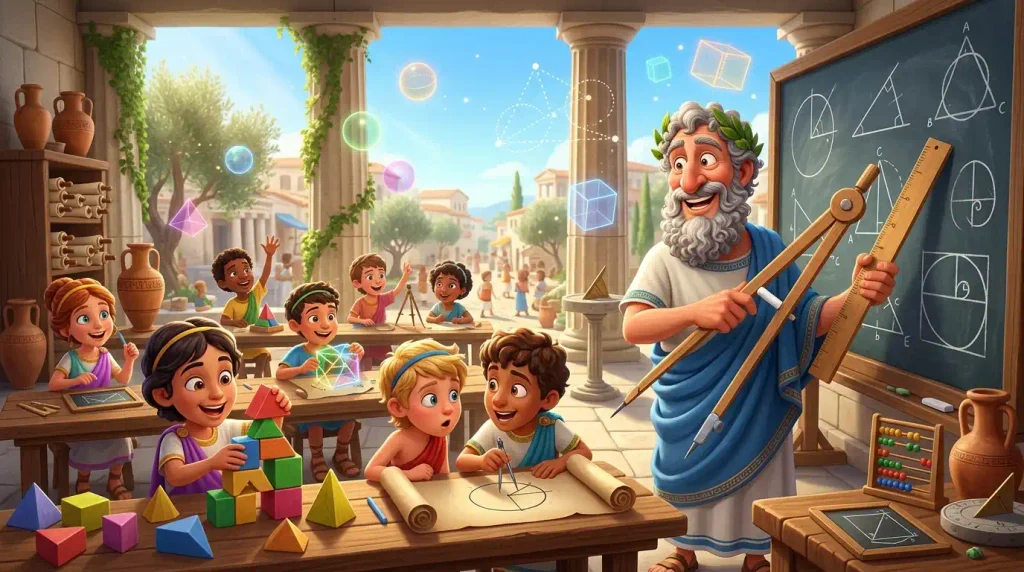
If you want to sharpen your logical thinking and problem-solving skills, studying Euclid’s classic approach to deductive reasoning offers incredible mental benefits that apply to daily life.
Start with Simple Straightedge and Compass Tools
Euclid completed all his geometric constructions using only two basic drawing tools: an unmarked straightedge ruler and a standard drawing compass. Trying to construct precise geometric shapes using only these classical tools trains your brain to visualize spatial relationships and think through multi-step logical problems systematically.
Practice Writing Step-by-Step Proofs
Euclid’s ultimate strength was his ability to prove ideas beyond any shadow of doubt by building on established truths. Try taking a simple statement, such as “the interior angles of a triangle equal 180 degrees,” and writing down the step-by-step logical chain required to prove it to a skeptic without making unproven assumptions.
Connect Geometry to Art and Nature
Look closely around your home, workplace, and neighborhood for Euclidean shapes and natural symmetry. You will quickly notice geometric principles operating in ceramic tile layouts, architectural window frames, plant leaf arrangements, and spider webs, bringing ancient mathematical theory to life in your everyday environment
Practice Exercise
Test your understanding of Euclid and his life’s work with these ten multiple-choice questions.
- Where did Euclid live and direct his famous mathematical school?
A. Athens, Greece
B. Rome, Italy
C. Alexandria, Egypt
D. Babylon, Iraq - What is the title of Euclid’s iconic thirteen-book series on geometry?
A. Principia
B. Elements
C. Mechanica
D. Dialogues - How many postulates did Euclid use as his foundation for plane geometry?
A. Three
B. Five
C. Ten
D. Twelve - Which American President studied Euclid’s proofs by candlelight to sharpen his mind?
A. George Washington
B. Thomas Jefferson
C. Abraham Lincoln
D. Theodore Roosevelt - What Latin phrase did medieval scholars abbreviate as Q.E.D. at the end of geometric proofs?
A. Quod Erat Demonstrandum
B. Quantum Est Datum
C. Quasi Ex Ratio
D. Quo Vadis Domine - What classical tools did Euclid use for geometric constructions?
A. Protractor and calculator
B. Straightedge and compass
C. Slide rule and graph paper
D. Measuring tape and level - What type of numbers did Euclid prove go on forever without ending?
A. Negative numbers
B. Even numbers
C. Prime numbers
D. Decimal numbers - How many regular Platonic solids did Euclid prove can exist in three-dimensional space?
A. Three
B. Five
C. Eight
D. Twelve - What modern technology relies on Euclid’s algorithm for finding greatest common divisors?
A. Digital computer encryption
B. Solar panel design
C. Gasoline engines
D. Hydraulic brakes - What famous response did Euclid give King Ptolemy I regarding learning geometry easily?
A. Geometry is only for scholars
B. Practice makes perfect
C. There is no royal road to geometry
D. Knowledge is true power
Answer Key
- C | 2. B | 3. B | 4. C | 5. A | 6. B | 7. C | 8. B | 9. A | 10. C
FAQs
What is Euclid most famous for?
Euclid is most famous for writing Elements, a groundbreaking thirteen-book masterwork that compiled, organized, and proved centuries of geometric knowledge into a clear, logical step-by-step system using fundamental axioms and rigorous deductive reasoning.
Why is Euclid called the Father of Geometry?
He earned the title “Father of Geometry” because he gathered scattered, unorganized mathematical ideas from earlier cultures and unified them into a structured, logical textbook system that served as the primary world standard for over two thousand years.
Did Euclid invent all of geometry by himself?
No, Euclid did not invent every geometric theorem himself. He compiled, edited, organized, and logically proved existing mathematical knowledge developed by earlier Greek, Egyptian, and Babylonian scholars, while contributing original proofs of his own.
What is the difference between Euclidean and non-Euclidean geometry?
Euclidean geometry deals with flat, two-dimensional surfaces where parallel lines never meet and triangle angles always sum to 180 degrees. Non-Euclidean geometry applies to curved surfaces, like spheres or saddles, where parallel lines can eventually intersect or diverge.
How did Euclid prove prime numbers are infinite?
Euclid used an elegant proof by contradiction. He assumed a finite list of all primes existed, multiplied them all together, and added one. This constructed a new number that proved another prime must always exist outside the original list.
Is Euclid’s geometry still taught in schools today?
Yes, secondary school geometry curricula across the globe still teach plane geometry based directly on Euclid’s original axioms, theorems, spatial constructions, and step-by-step logical proof methods.
Conclusion
Exploring these eye-opening Euclid fun facts demonstrates how an ancient scholar built an enduring framework of logic that still powers modern technology, engineering, and architecture. Euclid proved to the world that clear thinking, systematic organization, and logical reasoning can create timeless knowledge that endures across millennia.
Whether you are admiring a modern skyscraper, playing a 3D video game, or using satellite navigation on your smartphone, you are experiencing Euclid’s living legacy in action every day. His step-by-step approach to proving mathematical truths remains one of humanity’s greatest intellectual achievements.
If you enjoyed discovering these mathematical secrets, share these fascinating Euclid fun facts with curious friends or science lovers and explore the hidden geometry surrounding you today!

Ghzala Rani is the creator and writer behind Funzonest.com, a website dedicated to making everyday topics more enjoyable, interesting, and easy to understand. With a passion for engaging content, Ghzala focuses on creating helpful articles that inform, entertain, and provide readers with useful ideas and insights.
Through Funzonest.com, Ghzala Rani aims to build a friendly online space where readers can discover fresh content and explore topics presented in a simple and enjoyable way. Her writing style focuses on clarity, originality, and reader value. She is committed to publishing well-researched and engaging content that keeps visitors informed while making their time on the website enjoyable.